Session 06 - Systems of Linear Equations
Mathematics for Master Students
Dr. Tobias Vlcek
Recap & Your Questions
Session 05 in a Nutshell
- First-order condition: optima hide where \(f'(x) = 0\), solve it for the candidates
- Second-order condition: \(f''(x^*) > 0\) a minimum, \(f''(x^*) < 0\) a maximum, a flat tangent alone is never enough
- On a closed interval, compare stationary points and endpoints, a boundary can win
- Profit peaks where marginal revenue = marginal cost
- The EOQ \(q^* = \sqrt{2DK/h}\) balances ordering against holding costs
Common Issues in the Homework
- Endpoints forgotten (P4): on \([0, 3]\) the interior stationary point gave the minimum \(-11\); the true maximum \(f(0) = 5\) sits at the boundary, the endpoints are always candidates
- The cap ignored (P5): the FOC returned \(q = 60\), but the plant makes at most \(50\). Since \(\pi'(50) = 10 > 0\), profit is still rising, the best feasible output is \(q = 50\), not \(60\)
- A sign slip in the SOC: \(f''(x^*) < 0\) is a maximum (concave), not a minimum, check the sign before naming the type
Which tasks gave you trouble? Bring them up now. We take the time to work through them before moving on.
Warm-Up: Recipe Check
Question
Minimise the cost \(C(q) = q^2 - 8q + 20\). Where is the minimum, and how do you know it is a minimum?
- FOC: \(C'(q) = 2q - 8 = 0 \;\Rightarrow\; q = 4\)
- SOC: \(C''(q) = 2 > 0\) → convex → a minimum, confirmed
- Value: \(C(4) = 16 - 32 + 20 = 4\), lowest cost at \(q = 4\)
Today’s Plan
- From one equation to a system: several conditions on several unknowns at once
- Gaussian elimination: a clean recipe for three unknowns
- How many solutions? one, none, or infinitely many
- Linear systems in business: equilibrium and production planning
- A look back: the toolkit you built across all six sessions
From One Equation to a System
What Makes an Equation Linear?
An equation is linear when every unknown appears on its own, to the first power, nothing more exotic.
- Linear: \(2x + 3y = 13\), or \(x_1 + 2x_2 + 2x_3 = 16\), a weighted sum of the variables
- Not linear: \(x^2 + y = 4\) (a square), \(\;xy = 6\) (a product), \(\;\sqrt{x} + y = 1\) (a root)
- The rule: no powers, no products of variables, no variables under roots or in exponents
- Linear systems are the ones we can solve with pure, mechanical bookkeeping
One Equation, Two Unknowns = a Line
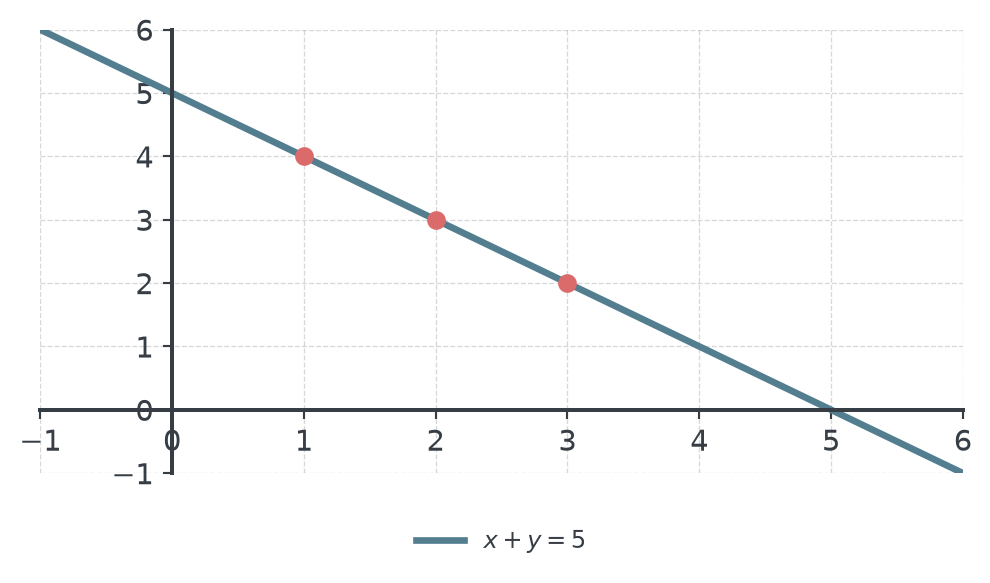
A single equation like \(x + y = 5\) has infinitely many solutions: \((1,4)\), \((2,3)\), \((3,2)\), …, every point on one line.
Your Turn: On the Line?
Question
Which point lies on the line \(\;2x + 3y = 13\)?
| (a) \((2, 3)\) | (b) \((3, 2)\) |
| (c) \((4, 1)\) | (d) \((1, 4)\) |
(a): \(2 \cdot 2 + 3 \cdot 3 = 13\) ✓. The others give \(12\), \(11\) and \(14\).
Checking a point is always cheap: substitute and compare. Remember \((2, 3)\), it returns in a moment.
A System Pins It Down
One condition leaves a whole line of choices. Add a second condition and the freedom shrinks.
- A system of linear equations asks several conditions to hold at the same time
- Business rarely has just one constraint: labour and material and budget
- Each equation is a line; a solution must sit on every line at once
- Two lines usually cross at a single point, one shared answer
A Two-Product Workshop
A furniture workshop makes chairs (\(x\)) and tables (\(y\)) and wants to use its resources fully this week:
- Wood: a chair takes \(2\) units, a table takes \(3\); \(13\) units are in stock \(\;\Rightarrow\; 2x + 3y = 13\)
- Labour: each item takes one day of work; \(5\) days are available \(\;\Rightarrow\; x + y = 5\)
- Two conditions, two unknowns, a \(2 \times 2\) system:
\[2x + 3y = 13 \qquad\qquad x + y = 5\]
Method 1: Substitution
Solve one equation for one variable, then substitute into the other.
- From the labour equation: \(\;x = 5 - y\)
- Put that into the wood equation: \(\;2(5 - y) + 3y = 13\)
- Expand: \(\;10 - 2y + 3y = 13 \;\Rightarrow\; 10 + y = 13\)
- So \(\;y = 3\), and back-substituting \(\;x = 5 - 3 = 2\)
- Solution: \(3\) tables and \(2\) chairs, i.e. \((x, y) = (2, 3)\)
Method 2: Elimination
Scale the equations so one variable cancels when you subtract.
- Multiply the labour equation by \(2\): \(\;2x + 2y = 10\)
- Subtract it from the wood equation: \[(2x + 3y) - (2x + 2y) = 13 - 10 \;\Rightarrow\; y = 3\]
- Back-substitute: \(\;x + 3 = 5 \;\Rightarrow\; x = 2\)
- Same solution \((2, 3)\), two roads, one destination
Your Turn: Two Trucks
Question
Two trucks carry \(10\) pallets in total, and the first carries \(4\) more than the second: \(\;x + y = 10, \quad x - y = 4\). Shout the solution \((x, y)\).
- Add the equations: \(2x = 14 \Rightarrow x = 7\)
- Back-substitute: \(7 + y = 10 \Rightarrow y = 3\)
- Check: \(7 - 3 = 4\) ✓, so \((x, y) = (7, 3)\)
Adding instead of subtracting is elimination too: whichever move makes a variable cancel.
Where the Lines Meet
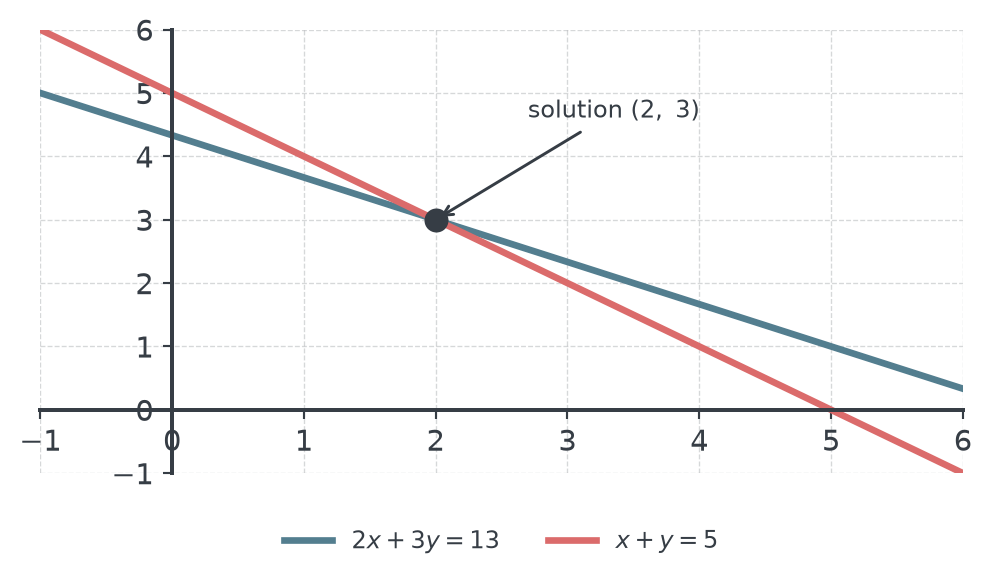
Always check: \(2(2) + 3(3) = 4 + 9 = 13\) ✓ and \(2 + 3 = 5\) ✓, the point sits on both lines.
Blending Two Coffees
A roaster blends beans at €8/kg and €12/kg into \(20\) kg costing €9/kg on average. How much of each?
- Quantity: \(x + y = 20\)
- Cost: \(8x + 12y = 9 \cdot 20 = 180\)
- Eliminate: \(8 \cdot (x + y) = 160\), subtract from the cost equation: \(4y = 20 \Rightarrow y = 5\)
- Back-substitute: \(x = 15\). Check: \(8 \cdot 15 + 12 \cdot 5 = 120 + 60 = 180\) ✓
Setting up the equations is the real work; solving them is Method 2 on autopilot.
Your Turn: Linear or Not?
Question
Is \(\;3xy = 12\;\) a linear equation in \(x\) and \(y\)?
- No, it multiplies the two unknowns together, and \(xy\) is a product of variables
- Linear equations only allow each variable on its own, to the first power
- A quick test: could you write it as (number)\(\cdot x\) + (number)\(\cdot y =\) number? Here you cannot
Three Unknowns: Gaussian Elimination
A Bigger System
For three unknowns, substitution gets messy. Our example for this section:
\[x + y + z = 9, \qquad x + 2y + 2z = 16, \qquad 2x + y + 3z = 17\]
Three conditions, three unknowns, and a lot of repetitive writing ahead. What we need first is a compact bookkeeping shorthand.
A Tidy Way to Write a System
The system is just its numbers, the augmented matrix (coefficients, then the right-hand side):
\[\left[\begin{array}{ccc|c} 1 & 1 & 1 & 9 \\ 1 & 2 & 2 & 16 \\ 2 & 1 & 3 & 17 \end{array}\right]\]
Each row is an equation; the bar just separates the left from the right side. No matrix algebra, pure bookkeeping.
Three Allowed Moves
We reshape the system with three row operations, each keeps the solution unchanged:
- Swap two rows (reorder the equations)
- Scale a row by a non-zero number (multiply or divide an equation)
- Add a multiple of one row to another (combine two equations)
The goal: create zeros below the diagonal, a triangular staircase we can read off from the bottom up.
Your Turn: Which Move Is Illegal?
Question
Which of these is not an allowed row operation?
| (a) Swap \(R_1\) and \(R_3\) | (b) Replace \(R_2\) by \(R_2 - 3R_1\) |
| (c) Multiply \(R_3\) by \(0\) | (d) Divide \(R_2\) by \(2\) |
(c): scaling by zero wipes the equation out, \(0 = 0\), and with it a condition on the unknowns. The solution set would change.
The other three moves only rewrite the same conditions in a new form: no information is lost, so the solution set cannot change.
Forward Elimination: Clear the First Column
Start from the augmented matrix and knock out the \(x\)-terms below the top row:
\[\left[\begin{array}{ccc|c} 1 & 1 & 1 & 9 \\ 1 & 2 & 2 & 16 \\ 2 & 1 & 3 & 17 \end{array}\right] \;\xrightarrow[\;R_3 \,\to\, R_3 - 2R_1\;]{\;R_2 \,\to\, R_2 - R_1\;}\; \left[\begin{array}{ccc|c} 1 & 1 & 1 & 9 \\ 0 & 1 & 1 & 7 \\ 0 & -1 & 1 & -1 \end{array}\right]\]
- \(R_2 - R_1\): \(\;(1,2,2\,|\,16) - (1,1,1\,|\,9) = (0,1,1\,|\,7)\)
- \(R_3 - 2R_1\): \(\;(2,1,3\,|\,17) - 2(1,1,1\,|\,9) = (0,-1,1\,|\,-1)\)
Your Turn: One Row Operation
Question
Rows \(R_1 = (1, 2, -1 \,|\, 3)\) and \(R_2 = (2, 5, 1 \,|\, 9)\). Compute \(R_2 - 2R_1\). Shout the new row.
\[(2, 5, 1 \,|\, 9) - 2 \cdot (1, 2, -1 \,|\, 3) = (2 - 2,\; 5 - 4,\; 1 + 2 \,|\, 9 - 6) = (0, 1, 3 \,|\, 3)\]
Common Mistake
\(1 - 2 \cdot (-1) = 1 + 2 = 3\), not \(-1\): subtracting a negative adds. And the right-hand side \(9 - 6 = 3\) must come along.
Forward Elimination: Clear the Second Column
Now use the new second row to clear the entry beneath it, then scale to a leading \(1\):
\[\left[\begin{array}{ccc|c} 1 & 1 & 1 & 9 \\ 0 & 1 & 1 & 7 \\ 0 & -1 & 1 & -1 \end{array}\right] \;\xrightarrow[\;R_3 \,\to\, R_3 / 2\;]{\;R_3 \,\to\, R_3 + R_2\;}\; \left[\begin{array}{ccc|c} 1 & 1 & 1 & 9 \\ 0 & 1 & 1 & 7 \\ 0 & 0 & 1 & 3 \end{array}\right]\]
- \(R_3 + R_2\): \(\;(0,-1,1\,|\,-1) + (0,1,1\,|\,7) = (0,0,2\,|\,6)\)
- \(R_3 / 2\): \(\;(0,0,2\,|\,6) \div 2 = (0,0,1\,|\,3)\)
Back-Substitution
The matrix is now triangular, zeros fill the lower-left corner. Read it from the bottom up:
\[x + y + z = 9, \qquad y + z = 7, \qquad z = 3\]
- Bottom row: \(\;z = 3\)
- Middle row: \(\;y + 3 = 7 \;\Rightarrow\; y = 4\)
- Top row: \(\;x + 4 + 3 = 9 \;\Rightarrow\; x = 2\)
- Solution: \((x, y, z) = (2, 4, 3)\)
Your Turn: Read It Bottom-Up
Question
A system is already triangular: \(\;x + 2y + z = 10, \quad y - z = 1, \quad z = 2\). What is \(x\)? Shout the number.
- Bottom: \(z = 2\)
- Middle: \(y - 2 = 1 \Rightarrow y = 3\)
- Top: \(x + 6 + 2 = 10 \Rightarrow x = 2\)
Solution \((2, 3, 2)\). Bottom-up is the only sensible order: each row hands one known value to the row above.
Always Verify
Plug the triple \((2, 4, 3)\) back into the original three equations:
- \(x + y + z = 2 + 4 + 3 = 9\) ✓
- \(x + 2y + 2z = 2 + 8 + 6 = 16\) ✓
- \(2x + y + 3z = 4 + 4 + 9 = 17\) ✓
Common Mistake
When you apply a row operation, act on the whole row, the right-hand side included. Subtracting \(2R_1\) from \(R_3\) but forgetting to also do \(17 - 2 \cdot 9 = -1\) silently corrupts the whole solve.
Gaussian Elimination in Four Steps
- Write the augmented matrix: coefficients left, right-hand sides right of the bar
- Eliminate forward: column by column, create zeros below the diagonal with row operations
- Back-substitute: read the triangular system from the bottom row up
- Verify: plug the solution into the original equations
Work on one column at a time and write every intermediate matrix down. Elimination fails through slips, not through difficulty.
Your Turn: Does Swapping Hurt?
Question
Halfway through, you swap two rows of the augmented matrix. Does that change the system’s solution?
- No, swapping rows just reorders the equations; the set of conditions is identical
- All three row operations are reversible and solution-preserving
- Swapping is often useful: it can bring a convenient \(1\) up to the pivot spot
How Many Solutions?
One, None, or Infinitely Many
A linear system has exactly one of three fates, there is no other possibility:
- Unique solution, the conditions pin down one answer (our examples so far)
- No solution, the conditions contradict each other
- Infinitely many solutions, a condition is redundant, leaving freedom
Geometry tells the story cleanly for two lines in the plane.
Two Lines: No Solution
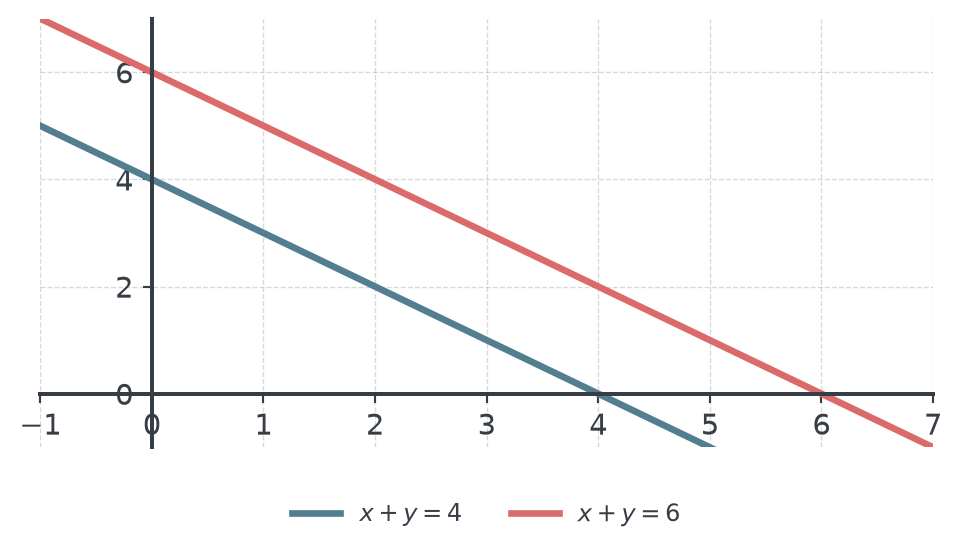
\(x + y = 4\) and \(x + y = 6\) are parallel, same slope, different heights. They never meet, so no pair \((x, y)\) satisfies both.
Two Lines: Infinitely Many
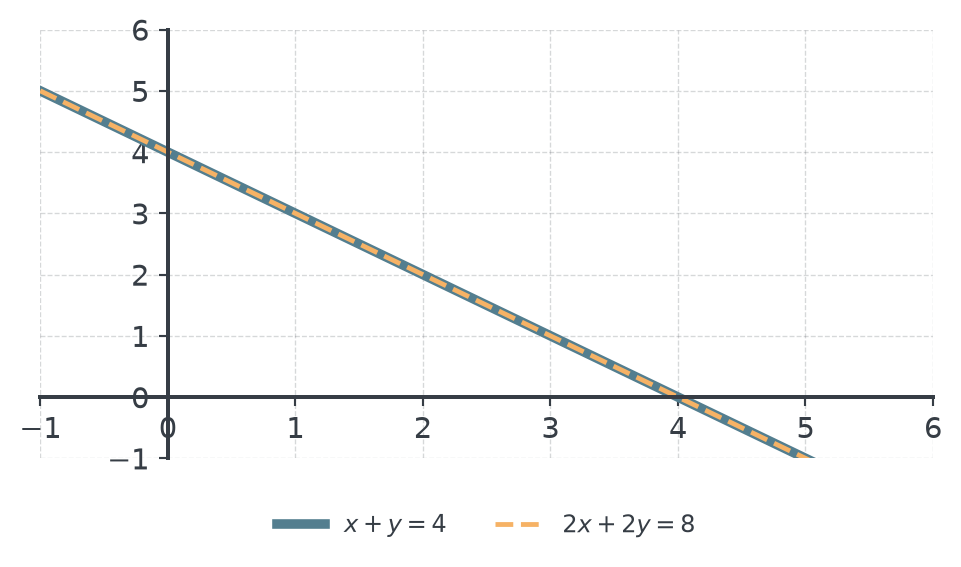
\(2x + 2y = 8\) is just \(x + y = 4\) doubled, the same line. Every point on it solves both; there are infinitely many solutions.
Parameterising the Free Case
When one equation adds nothing new, we describe all solutions with a free parameter.
For \(x + y = 4\) with a redundant partner:
- Let \(y = t\) be free, any real number
- Then \(x = 4 - t\)
- Solution set: \((x, y) = (4 - t,\; t)\), one point for each \(t\)
- E.g. \(t = 0 \to (4, 0)\), \(\;t = 1 \to (3, 1)\), \(\;t = 4 \to (0, 4)\)
Your Turn: Pick a Solution
Question
The solution set is \((x, y) = (4 - t,\; t)\). Which point belongs to it?
| (a) \((5, 1)\) | (b) \((1, 3)\) |
| (c) \((3, 2)\) | (d) \((2, 4)\) |
(b): \(t = 3\) gives \((4 - 3, 3) = (1, 3)\). Equivalently, \(1 + 3 = 4\) ✓.
The quick test is the original equation \(x + y = 4\): the other three sum to \(6\), \(5\) and \(6\).
Three Unknowns: Planes Instead of Lines
With three unknowns, each equation is a plane in space, but the same three fates return:
- Unique: three planes meet at a single point (our Gaussian example)
- None: the planes have no common point, like parallel walls
- Infinitely many: they share a whole line (or plane) of points
- The geometry grows, but elimination handles all of it the same way
How Elimination Announces the Case
You do not need the picture, the triangular form tells you which fate you have:
- A clean staircase with a leading \(1\) in every column → unique solution
- A row like \(\;0 \; = \; 5\;\) (all coefficients zero, non-zero right side) → no solution
- A row like \(\;0 \; = \; 0\;\) (an entire row vanishes) → infinitely many, a free parameter
A Contradiction Appears
Change the last equation of our \(3 \times 3\) system to \(\;2x + 3y + 3z = 20\):
\[\left[\begin{array}{ccc|c} 1 & 1 & 1 & 9 \\ 1 & 2 & 2 & 16 \\ 2 & 3 & 3 & 20 \end{array}\right] \;\xrightarrow[\;R_3 \,\to\, R_3 - 2R_1\;]{\;R_2 \,\to\, R_2 - R_1\;}\; \left[\begin{array}{ccc|c} 1 & 1 & 1 & 9 \\ 0 & 1 & 1 & 7 \\ 0 & 1 & 1 & 2 \end{array}\right] \;\xrightarrow{\;R_3 \,\to\, R_3 - R_2\;}\; \left[\begin{array}{ccc|c} 1 & 1 & 1 & 9 \\ 0 & 1 & 1 & 7 \\ 0 & 0 & 0 & -5 \end{array}\right]\]
The last row reads \(0 = -5\): impossible. The second and third equations demand \(y + z = 7\) and \(y + z = 2\) at once, so there is no solution.
Worked Example: A Row Vanishes
Now with right-hand side \(25\) instead: \(\;2x + 3y + 3z = 25\)
\[\left[\begin{array}{ccc|c} 1 & 1 & 1 & 9 \\ 1 & 2 & 2 & 16 \\ 2 & 3 & 3 & 25 \end{array}\right] \;\xrightarrow[\;R_3 \,\to\, R_3 - 2R_1\;]{\;R_2 \,\to\, R_2 - R_1\;}\; \left[\begin{array}{ccc|c} 1 & 1 & 1 & 9 \\ 0 & 1 & 1 & 7 \\ 0 & 1 & 1 & 7 \end{array}\right] \;\xrightarrow{\;R_3 \,\to\, R_3 - R_2\;}\; \left[\begin{array}{ccc|c} 1 & 1 & 1 & 9 \\ 0 & 1 & 1 & 7 \\ 0 & 0 & 0 & 0 \end{array}\right]\]
- The third equation was the sum of the first two: \(0 = 0\), redundant
- Two real conditions, three unknowns: let \(z = t\) be free
- Then \(y = 7 - t\) and \(x = 9 - y - z = 2\): solutions \((2,\; 7 - t,\; t)\) for every \(t\)
Your Turn: How Many Solutions?
Question
\(\;x + 2y = 6\;\) and \(\;2x + 4y = 8\). How many solutions does the system have?
| (a) Exactly one | (b) None |
| (c) Infinitely many | (d) Exactly two |
(b): doubling the first equation gives \(2x + 4y = 12\), but the second demands \(2x + 4y = 8\). Same slope, different height: parallel lines.
Elimination says the same: \(R_2 - 2R_1\) leaves \(\;0 = -4\). And (d) is never an option: two distinct lines cross at most once.
Read the Zero Row Carefully
Common Mistake
A vanished row \(\;0 = 0\;\) means the equation was redundant, the system has infinitely many solutions, not “no solution”. “No solution” only appears as \(\;0 = (\text{non-zero})\), a genuine contradiction. Read the right-hand side before you decide.
Your Turn: Reading the Outcome
Question
During elimination a row collapses to \(\;0 = 0\). Does the system have a unique solution, no solution, or infinitely many?
- \(\;0 = 0\;\) is always true, that equation carried no new information
- Fewer real conditions than unknowns leaves a variable free
- So the system has infinitely many solutions, parameterise the free one
Linear Systems in Business
Market Equilibrium
A market clears where supply meets demand, quantity offered equals quantity wanted.
For a product at price \(p\), suppose
- Demand: \(q = 120 - 2p\), buyers want less as the price rises
- Supply: \(q = 3p - 30\), sellers offer more as the price rises
- Equilibrium is the price and quantity solving both at once, a \(2 \times 2\) system
Solving for Equilibrium
Both express \(q\), so set them equal, or eliminate \(q\) from the system \[q + 2p = 120, \qquad q - 3p = -30.\]
- Subtract the second from the first: \(\;5p = 150 \;\Rightarrow\; p = 30\)
- Back-substitute: \(\;q = 120 - 2(30) = 60\)
- Equilibrium: price €30, quantity \(60\) units
- Check the supply side: \(\;3(30) - 30 = 60\) ✓
Your Turn: Find the Equilibrium
Question
Another market: demand \(q = 100 - p\), supply \(q = 2p - 20\). What is the equilibrium price? Shout the number.
\[100 - p = 2p - 20 \quad \Rightarrow \quad 120 = 3p \quad \Rightarrow \quad p = 40, \qquad q = 100 - 40 = 60\]
Check the supply side: \(2 \cdot 40 - 20 = 60\) ✓. Price €40, quantity \(60\) units.
Supply Meets Demand
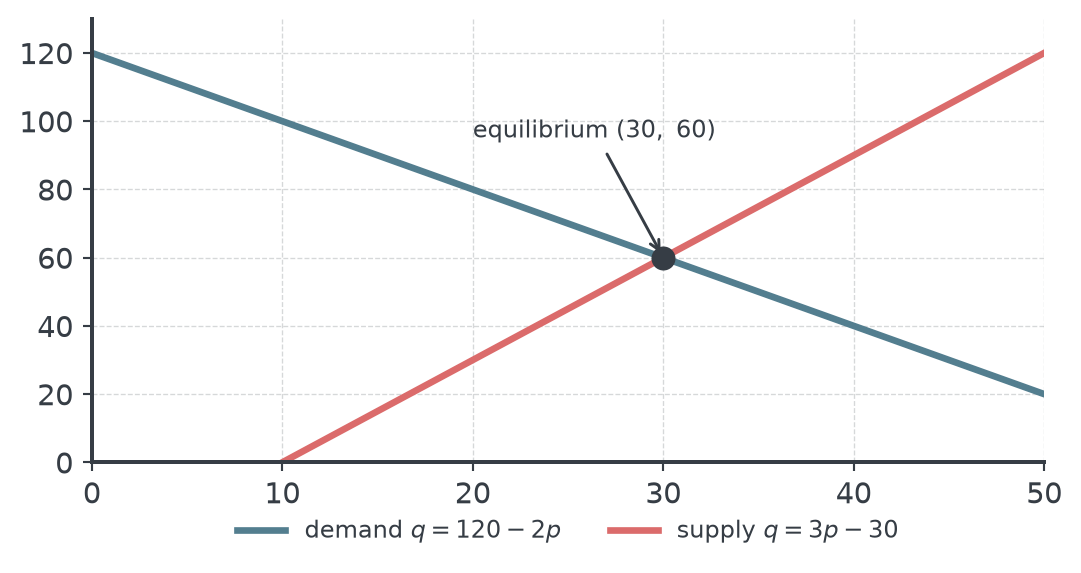
Below €30 buyers outnumber sellers (shortage); above it sellers outnumber buyers (surplus). The lines cross where the market balances.
Your Turn: Above the Equilibrium
Question
The price is set at €40, above the equilibrium of €30. Is there excess supply or excess demand?
- Demand at €40: \(\;120 - 80 = 40\); supply at €40: \(\;3 \cdot 40 - 30 = 90\)
- Sellers offer \(90\) but buyers want only \(40\), a surplus of \(50\) units
- Above equilibrium there is excess supply; price pressure pushes back down toward €30
Where the 3×3 Came From
Remember the system we solved by elimination? It was a production plan all along.
A workshop makes three products \(x, y, z\) and wants to use every resource fully:
- Packaging: one unit each, \(9\) available \(\;\Rightarrow\; x + y + z = 9\)
- Labour: \(1, 2, 2\) hours per product, \(16\) hours \(\;\Rightarrow\; x + 2y + 2z = 16\)
- Machine: \(2, 1, 3\) hours per product, \(17\) hours \(\;\Rightarrow\; 2x + y + 3z = 17\)
Reading the Production Plan
We already found the unique solution by Gaussian elimination: \[(x, y, z) = (2, 4, 3)\]
- Make 2 of product \(x\), 4 of product \(y\), 3 of product \(z\)
- Every resource is used to the last unit: \(9\) packaging, \(16\) labour, \(17\) machine hours
- One tidy elimination turned three resource limits into a concrete production schedule
- The same recipe scales to the large planning systems behind real logistics software
Your Turn: Check a Rival Plan
Question
A colleague proposes the plan \((x, y, z) = (3, 3, 3)\) instead. Which resource does it exceed?
| (a) Packaging (\(9\)) | (b) Labour (\(16\) h) |
| (c) Machine (\(17\) h) | (d) None, it also works |
(c): packaging \(3 + 3 + 3 = 9\) ✓, labour \(3 + 6 + 6 = 15 \leq 16\), but machine time \(6 + 3 + 9 = 18 > 17\).
A linear system with a unique solution has exactly one plan that uses every resource fully; any other plan breaks a limit, leaves something idle, or, as here, both.
Closing
Key Takeaways
- A linear equation is a plain weighted sum of unknowns, one such equation in two unknowns is a line
- Solve a \(2 \times 2\) system by substitution or elimination, both give the same crossing point
- Gaussian elimination reduces a \(3 \times 3\) system to triangular form, then back-substitutes
- Every system has one, none, or infinitely many solutions, the triangular form reveals which
- Equilibrium and production planning are linear systems in business dress
That’s it for today.
Any Questions?
Voluntary Mock Exam
To round off the tutorial, there is a voluntary mock exam covering Sessions 1–6.
- An interactive self-test with exam-style questions, no grade attached
- When: Tue 27 Oct 2026, 14:30–16:00, in the Auditorium (note the earlier start)
- How to prepare: rework the tasks, retry the self-test quizzes, and keep the cheatsheets beside you
- Released on the day, and we work through it together in class
Until the Mock Exam
- Work through the Tasks: systems drills with worked solutions
- Check yourself with the Self-Test quiz
- Keep the Cheatsheet handy, elimination in a nutshell
- Then put it all together in the final session’s mock exam
The Toolkit You Built
Six sessions, one steadily growing toolkit for the maths behind your M.Sc. courses:
- Notation & logic, then sets, the language to state ideas precisely
- Functions: how one quantity depends on another, and how to read a graph
- Differentiation: rates of change and the shape of a curve
- Optimisation: turning a flat tangent into the best decision
- Linear systems: solving for several unknowns at once
You are ready for the mock exam, and for the maths your degree will lean on.
Literature & Further Reading
- These sessions cover the essentials: textbooks offer more depth and practice
- Start with Sydsæter et al. (2012) or Jacques (2015); full recommendations on the tutorial’s literature page
Jacques, Ian. 2015. Mathematics for Economics and Business. 8th ed. Always Learning. Pearson.
Sydsæter, Knut, Peter J. Hammond, and Arne Strøm. 2012. Essential Mathematics for Economic Analysis. 4th ed. Pearson.
Session 06 - Systems of Linear Equations | Dr. Tobias Vlcek | Home