Session 04 - Differentiation
Mathematics for Master Students
Dr. Tobias Vlcek
Recap & Your Questions
Session 03 in a Nutshell
- A function assigns each input exactly one output
- The gallery: linear, quadratic, polynomial, rational, exponential, logarithm
- Maximal domain, red flags: division by zero, roots of negatives, logs of non-positives
- Composition chains functions (order matters); inverses undo
- Convex vs concave: where the chord lies relative to the graph
- Today: how fast does the output change, \(f(a+h)\) finally pays off
Common Issues in the Homework
- One restriction forgotten: with \(\frac{\sqrt{x+1}}{x-2}\), both the root (\(x \geq -1\)) and the denominator (\(x \neq 2\)) restrict: collect every red flag, then intersect
- Composition order: \((f \circ g)(x)\) means \(g\) acts first. Several solutions applied \(f\) first
- The log-inequality flip: dividing by \(\ln 0.85 < 0\) flips the inequality. Dividing by a negative number always does
Which tasks gave you trouble? Bring them up now. We take the time to go through them before we move on to today’s topic.
Warm-Up: Compose and Restrict
Question
Let \(f(x) = \sqrt{x}\) and \(g(x) = 2x + 7\). Compute \(\;(f \circ g)(1)\;\) and find the domain of \(f \circ g\).
- Inside out: \((f \circ g)(1) = f(g(1)) = f(9) = 3\)
- The root needs \(g(x) \geq 0\): \(\;2x + 7 \geq 0\), so \(x \geq -\frac{7}{2}\)
- Domain of \(f \circ g\): \(\;[-\frac{7}{2}, \infty)\), the inner function must land where the outer one is defined
Today’s Plan
- Rates of change: from secant lines to the tangent and the derivative
- Rules of differentiation: power, sum, product, quotient, chain, \(e^x\) and \(\ln x\)
- Second derivative: the convex/concave intuition made precise
- Marginal analysis: marginal cost, marginal revenue, elasticity of demand
Rates of Change
How Fast Does Revenue React?
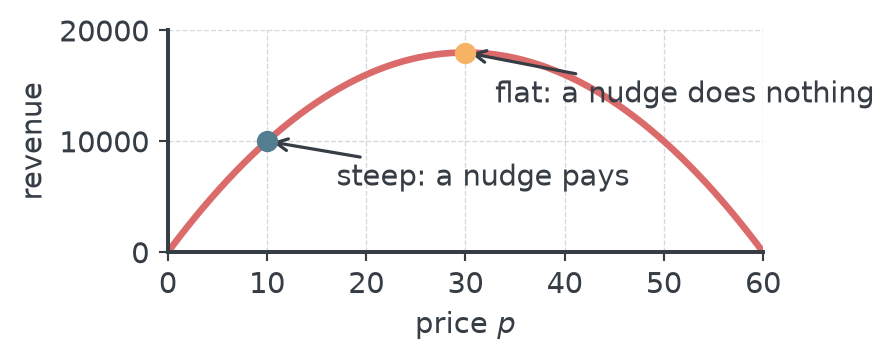
Session 3 modelled revenue as a function of price: \(R(p) = 1200p - 20p^2\).
- A pricing decision is rarely “pick \(p\) from scratch”, it is nudge the current price a little
- Central question: if I move the price from \(p\) to \(p + h\), how fast does revenue react?
- The answer depends on where we stand on the curve. Let’s look
The Same Nudge, Very Different Effects
Raising the price by €1 gains exactly €780 of revenue at \(p = 10\), but loses €20 at \(p = 30\). One curve, very different local behaviour.
The Average Rate of Change
How much does \(f\) change per unit of input, between \(a\) and \(a + h\)?
\[\frac{f(a+h) - f(a)}{h} \qquad \text{the [difference quotient]{.highlight}}\]
- Change in output divided by change in input, “rise over run”
- The numerator is exactly Session 3’s expression \(f(a+h)\) minus \(f(a)\), the raw material, cashed in
- For a linear function this is always the slope \(m\). For a curved graph it depends on \(a\) and \(h\)
Geometry: The Secant Line
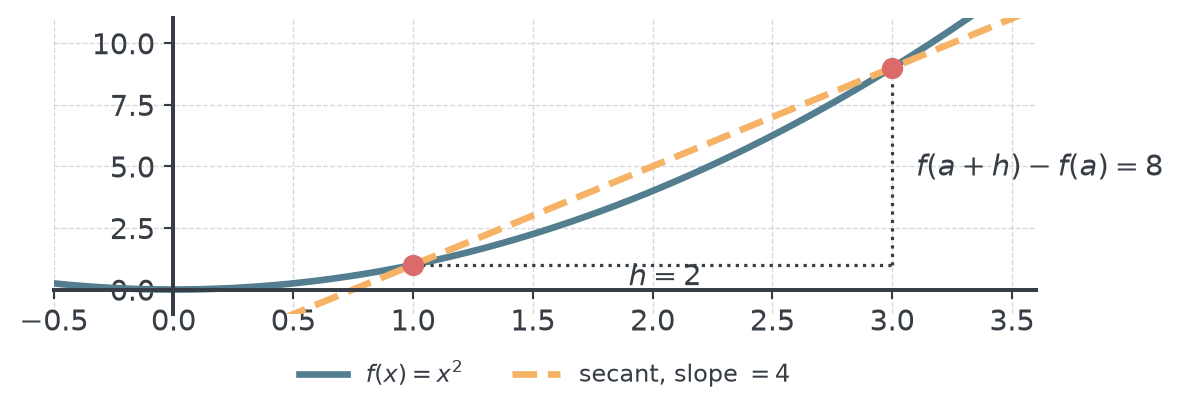
The difference quotient is the slope of the secant line through \((a, f(a))\) and \((a+h, f(a+h))\): here \(\frac{9 - 1}{2} = 4\) for \(f(x) = x^2\) from \(a = 1\) to \(a + h = 3\).
Your Turn: Compute the Secant Slope
Question
For \(f(x) = x^2\), what is the difference quotient from \(a = 2\) to \(a + h = 4\)? Type the number in the chat.
\[\frac{f(4) - f(2)}{4 - 2} = \frac{16 - 4}{2} = 6\]
The secant from \(1\) to \(3\) had slope \(4\), this one has slope \(6\): the parabola gets steeper as we move right, exactly what the next slides confirm.
From Secant to Tangent
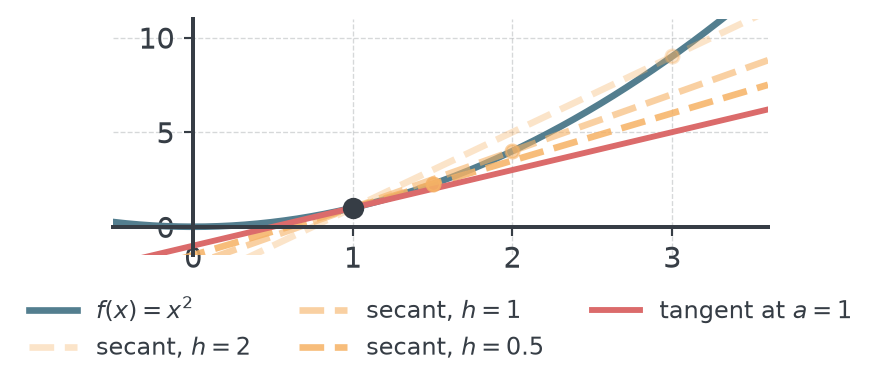
Keep \(a\) fixed and pull the second point closer: the secants tilt toward one limiting line, the tangent at \(a\). Its slope is the rate of change right at \(a\).
Letting \(h\) Shrink
For \(f(x) = x^2\) at \(a = 1\), the secant slope is \(\frac{(1+h)^2 - 1}{h}\):
| \(h\) | \(1\) | \(0.5\) | \(0.1\) | \(0.01\) | \(0.001\) |
|---|---|---|---|---|---|
| secant slope | \(3\) | \(2.5\) | \(2.1\) | \(2.01\) | \(2.001\) |
- As \(h\) shrinks toward \(0\), the slopes settle on the value \(2\)
- We write \(\lim_{h \to 0}\) for “the value it settles on as \(h\) shrinks toward \(0\)”
- That is all the limit machinery we need, no formal theory required in this tutorial
The Derivative
The derivative of \(f\) at \(a\) is the instantaneous rate of change:
\[f'(a) = \lim_{h \to 0} \frac{f(a+h) - f(a)}{h}\]
- Geometric reading: slope of the tangent line at \((a, f(a))\)
- Business reading: how fast the output reacts to a tiny nudge at \(a\)
- Computed at every point, it defines a new function \(f'\), the derivative of \(f\)
- Positive \(f'\): increasing; negative \(f'\): decreasing; the sign is a trend report
Your Turn: Read the Sign
Question
You are told \(f'(a) = -3\). What does that say?
| (a) \(f\) is decreasing at \(a\), with tangent slope \(-3\) | (b) \(f(a) = -3\) |
| (c) \(f\) has a minimum at \(a\) | (d) \(f\) drops by exactly \(3\) between \(a\) and \(a + 1\) |
(a): the derivative is a slope, and a negative slope means the graph falls at \(a\).
- is only approximately right, and only for a nearly straight graph: the tangent slope describes the trend at \(a\), not a whole unit further on. (b) confuses the value with the slope.
Worked Example: Differentiating \(f(x) = x^2\)
- Expand (Session 3 did this): \(f(a+h) = (a+h)^2 = a^2 + 2ah + h^2\)
- Subtract: \(f(a+h) - f(a) = 2ah + h^2\)
- Divide by \(h\): \(\dfrac{2ah + h^2}{h} = 2a + h\)
- Shrink \(h\) toward 0: \(\;f'(a) = 2a\)
Check against the table: at \(a = 1\) we get \(f'(1) = 2\), exactly where the secant slopes settled. And at \(a = 3\): slope \(6\), the parabola gets steeper as we move right.
Notation for Derivatives
All of these mean the same thing:
| Notation | Read as |
|---|---|
| \(f'(x)\) | “\(f\) prime of \(x\)” |
| \(\dfrac{df}{dx}\) | “derivative of \(f\) with respect to \(x\)” |
| \(\dfrac{d}{dx} f(x)\) | “\(\frac{d}{dx}\) applied to \(f(x)\)” |
\(\frac{df}{dx}\) deliberately looks like a difference quotient: it reminds you where the derivative comes from. We mostly write \(f'(x)\); with several variables around (e.g. \(C(q)\)), the \(\frac{dC}{dq}\) form says with respect to what.
The Tangent as a Local Approximation
Near \(a\), the graph and its tangent are almost indistinguishable:
\[f(a + h) \;\approx\; f(a) + f'(a) \cdot h \qquad \text{for small } h\]
- The difference quotient rearranged: \(f'(a) \approx \frac{f(a+h) - f(a)}{h}\), multiply by \(h\) and move \(f(a)\) across
- Example: \(f(x) = x^2\) at \(a = 3\), \(f'(3) = 6\): \(\;f(3.1) \approx 9 + 6 \cdot 0.1 = 9.6\), exact value \(9.61\)
- Business reading: “one more unit changes the output by about \(f'(a)\)”, the idea behind marginal cost, later today
Your Turn: Average vs Instantaneous
Question
A courier van covers 150 km in 2 hours. Halfway through, a speed camera clocks it at 90 km/h. Which number is an average rate of change, which is a derivative, and can both be correct at once?
- \(\frac{150}{2} = 75\) km/h is a difference quotient, distance change over time change
- The camera reading is the instantaneous rate, the derivative of distance at that moment
- Both are correct: the average smooths out faster and slower stretches
Not Every Function Has a Derivative
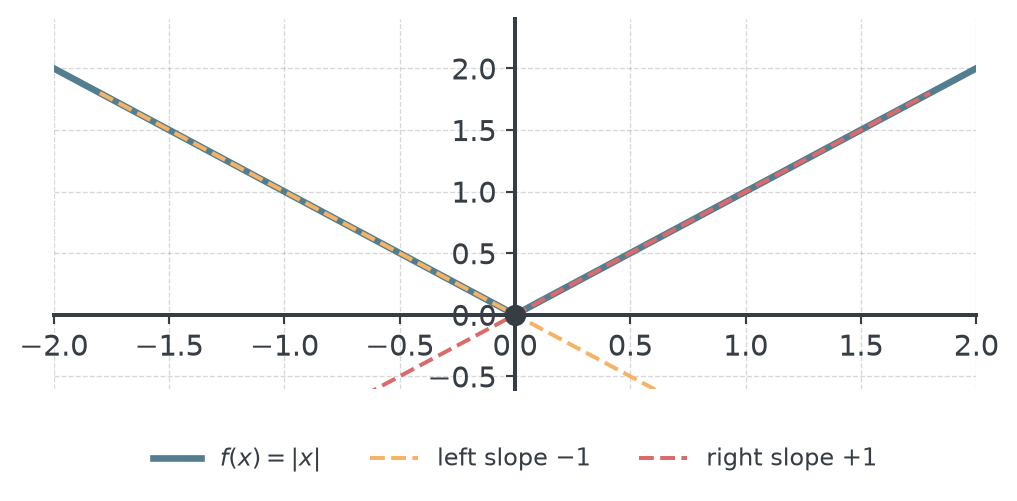
Kinks, Jumps, and Smoothness
- At the kink, secants from the left settle on \(-1\), from the right on \(+1\): no single tangent, no derivative at \(0\)
- Jumps are even worse: no tangent can be drawn across a gap
- Intuition: differentiable = smooth graph: no kinks, no jumps (tiered shipping tariffs kink at the breakpoints)
Rules of Differentiation
Constants and the Power Rule
Nobody computes difference quotients all day, rules do the work:
- Constants: \(f(x) = c\) has \(f'(x) = 0\), a horizontal line has slope zero
- Power rule: \(f(x) = x^n\) has \(f'(x) = n x^{n-1}\)
- Recipe: exponent down front, then reduce the exponent by one
- Example: \((x^5)' = 5x^4\), and our \((x^2)' = 2x\) is the case \(n = 2\)
The Power Rule Takes All Exponents
The rule also covers negative and fractional exponents, rewrite first:
- \(\dfrac{1}{x} = x^{-1}\), so \(\left(\dfrac{1}{x}\right)' = -1 \cdot x^{-2} = -\dfrac{1}{x^2}\)
- \(\sqrt{x} = x^{1/2}\), so \(\left(\sqrt{x}\right)' = \dfrac{1}{2} x^{-1/2} = \dfrac{1}{2\sqrt{x}}\)
Session 3’s exponent rules pay off: rewrite as a power, differentiate, translate back. Fractions and roots stop being special cases.
Your Turn: Apply the Power Rule
Question
Let \(f(x) = x^4\). What is \(f'(2)\)? Type the number. Bonus: differentiate \(g(x) = \dfrac{1}{x^2}\).
\[f'(x) = 4x^3, \qquad f'(2) = 4 \cdot 8 = 32\]
\[g(x) = x^{-2}, \qquad g'(x) = -2x^{-3} = -\frac{2}{x^3}\]
Common Mistake
\(f'(2) = 4 \cdot 2^4 = 64\) forgets to reduce the exponent. Exponent down front and one less on top.
Sums and Constant Multiples
\[(c \cdot f)'(x) = c \cdot f'(x) \qquad (f + g)'(x) = f'(x) + g'(x)\]
- Together: differentiate term by term, constants tag along
- Example, a cost function: \(C(q) = 0.5q^2 + 10q + 200\)
- \(C'(q) = 0.5 \cdot 2q + 10 + 0 = q + 10\)
- The fixed costs \(200\) vanish: they do not react to producing one unit more
Every polynomial is now differentiable in one line. Keep \(C'(q) = q + 10\) in mind, it returns later today.
A Cubic Revenue Function
Revenue from a promotion budget \(x\): \(\;R(x) = -0.5x^3 + 6x^2 + 20x\)
- Term by term: \((-0.5x^3)' = -1.5x^2\), \(\;(6x^2)' = 12x\), \(\;(20x)' = 20\)
- So \(R'(x) = -1.5x^2 + 12x + 20\)
- At \(x = 2\): \(R'(2) = -6 + 24 + 20 = 38 > 0\), revenue still rises with the budget
- At \(x = 10\): \(R'(10) = -150 + 120 + 20 = -10 < 0\), the budget has overshot
The sign of \(R'\) is the trend report: positive means “spend more”, negative means “you overshot”.
Your Turn: Differentiate Term by Term
Question
A cost function is \(C(q) = 0.1q^2 + 4q + 50\). What is \(C'(20)\)? Type the number.
\[C'(q) = 0.2q + 4, \qquad C'(20) = 4 + 4 = 8\]
At \(20\) units, cost grows at €8 per unit, while the fixed cost \(50\) has disappeared from \(C'\) entirely: it never reacts to output.
The Product Rule
\[(f \cdot g)'(x) = f'(x)\,g(x) + f(x)\,g'(x)\]
- “Derivative of the first times the second, plus the first times derivative of the second”
- Example: \(u(x) = (x^2 + 1)(3x - 2)\)
- \(u'(x) = 2x \cdot (3x - 2) + (x^2 + 1) \cdot 3 = 9x^2 - 4x + 3\)
- Check: expanding first gives \(u(x) = 3x^3 - 2x^2 + 3x - 2\), so \(u'(x) = 9x^2 - 4x + 3\) ✓
Common Mistake
\((f \cdot g)' \neq f' \cdot g'\), try \(f(x) = g(x) = x\): the product \(x^2\) has derivative \(2x\), not \(1\).
The Quotient Rule
\[\left(\frac{f}{g}\right)'(x) = \frac{f'(x)\,g(x) - f(x)\,g'(x)}{\left(g(x)\right)^2}\]
- Like the product rule, but with a minus, the numerator’s order matters
- Example, Session 3’s average cost per unit: \(A(q) = \frac{200 + 5q}{q}\)
- \(A'(q) = \frac{5 \cdot q - (200 + 5q) \cdot 1}{q^2} = -\frac{200}{q^2}\)
- Always negative: average cost falls as volume grows: economies of scale, now proven
The Chain Rule
For a composition \((f \circ g)(x) = f(g(x))\), Session 3’s chaining:
\[\left(f(g(x))\right)' = f'(g(x)) \cdot g'(x)\]
- Recipe: outer derivative (inner left untouched) times inner derivative
- Example: \(v(x) = (2x^2 + 1)^3\), outer \((\cdot)^3\), inner \(2x^2 + 1\)
- \(v'(x) = 3(2x^2 + 1)^2 \cdot 4x = 12x\,(2x^2 + 1)^2\)
Common Mistake
Stopping at \(3(2x^2 + 1)^2\), the inner derivative \(4x\) must come along. Forgetting it is the classic chain-rule slip.
Your Turn: Spot the Missing Factor
Question
What is the derivative of \(\;(3x + 2)^5\)?
| (a) \(5(3x + 2)^4\) | (b) \(15(3x + 2)^4\) |
| (c) \(5 \cdot 3^4\) | (d) \(15x\,(3x + 2)^4\) |
(b): outer derivative \(5(3x+2)^4\), times the inner derivative \(3\).
- forgot the inner factor, (c) differentiated the bracket away, (d) invented an \(x\): the inner derivative of \(3x + 2\) is the constant \(3\), nothing more.
Chain Rule in Business: Rates Multiply
A warehouse’s stock grows over time, and storage cost depends on stock:
\[q(t) = 30 + 4t \ \text{ pallets after } t \text{ weeks}, \qquad S(q) = 0.2q^2 \ \text{ cost in €}\]
How fast does the cost grow over time? Differentiate the chain \(S(q(t))\):
\[\frac{dS}{dt} = S'(q) \cdot q'(t) = 0.4q \cdot 4 = 1.6\,(30 + 4t)\]
- At \(t = 5\): stock \(q = 50\), and cost rises at \(1.6 \cdot 50 = 80\), €80 per week
- The chain rule multiplies the rates along the chain: € per pallet times pallets per week
Your Turn: Pick the Rule
Question
Which rule differentiates each function, and what are the derivatives?
\[\text{(a) } (5x + 1)^4 \qquad \text{(b) } x^3(2x - 7) \qquad \text{(c) } \frac{x}{x^2 + 1}\]
- (a) Chain rule, outer \((\cdot)^4\), inner \(5x + 1\): derivative \(4(5x+1)^3 \cdot 5 = 20(5x+1)^3\)
- (b) Product rule, or expand to \(2x^4 - 7x^3\) and use the power rule: both give \(8x^3 - 21x^2\)
- (c) Quotient rule: \(\left(\frac{x}{x^2+1}\right)' = \frac{1 \cdot (x^2 + 1) - x \cdot 2x}{(x^2 + 1)^2} = \frac{1 - x^2}{(x^2 + 1)^2}\)
Derivatives of \(e^x\) and \(\ln x\)
- \(\left(e^x\right)' = e^x\), the exponential is its own derivative: at every point, slope = height
- \(\left(\ln x\right)' = \dfrac{1}{x}\), steep near \(0\), ever flatter afterwards: diminishing returns
- Other bases pick up a factor: \(\left(a^x\right)' = a^x \ln a\)
- \(e\) is exactly the base where that factor is \(\ln e = 1\), the tidy one
- With the chain rule: \(\left(e^{3x}\right)' = e^{3x} \cdot 3 = 3e^{3x}\)
Worked Example: Mixing the Rules
Differentiate \(\;u(x) = x \cdot e^{x}\;\) and \(\;v(x) = \ln(x^2 + 1)\).
- \(u\) is a product: \(u'(x) = 1 \cdot e^x + x \cdot e^x = (1 + x)\,e^x\)
- \(v\) is a chain: outer \(\ln(\cdot)\) with derivative \(\frac{1}{(\cdot)}\), inner \(x^2 + 1\) with derivative \(2x\)
- \(v'(x) = \dfrac{1}{x^2 + 1} \cdot 2x = \dfrac{2x}{x^2 + 1}\)
Name the structure first, product or chain, and the rule follows. Two rules can also nest: \(\left(x e^{2x}\right)'\) is a product whose second factor needs the chain rule.
Your Turn: Exponential and Log
Question
Differentiate \(\;f(x) = e^{2x}\;\) and \(\;g(x) = \ln(5x)\). Type both derivatives in the chat.
- \(f'(x) = e^{2x} \cdot 2 = 2e^{2x}\): outer \(e^{(\cdot)}\), inner derivative \(2\)
- \(g'(x) = \dfrac{1}{5x} \cdot 5 = \dfrac{1}{x}\): the \(5\) cancels
- No surprise: \(\ln(5x) = \ln 5 + \ln x\), and the constant \(\ln 5\) differentiates to zero
The Superpower of \(e\)
Session 3’s continuous growth: \(K(t) = K_0 \cdot e^{rt}\). Differentiate (chain rule):
\[K'(t) = K_0 \, e^{rt} \cdot r = r \cdot K(t)\]
- The growth rate is proportional to the current level: at every instant, capital grows at \(r\) times itself
- That is the defining property of exponential growth: interest earns interest
- This is why \(e\) rules finance and growth models, the promised superpower
The Rule Table
Building blocks
| \(f(x)\) | \(f'(x)\) |
|---|---|
| \(c\) | \(0\) |
| \(x^n\) | \(n x^{n-1}\) |
| \(e^x\) | \(e^x\) |
| \(a^x\) | \(a^x \ln a\) |
| \(\ln x\) | \(\frac{1}{x}\) |
Combination rules
| Rule | Formula |
|---|---|
| Constant multiple | \((c f)' = c f'\) |
| Sum | \((f + g)' = f' + g'\) |
| Product | \((f g)' = f'g + f g'\) |
| Quotient | \(\left(\frac{f}{g}\right)' = \frac{f'g - f g'}{g^2}\) |
| Chain | \((f(g))' = f'(g) \cdot g'\) |
These ten lines differentiate every function in Session 3’s gallery: practice comes with the tasks, the table lives on the cheatsheet.
Higher-Order Derivatives & Curvature
Differentiating Twice
\(f'\) is again a function, so differentiate again:
\[f''(x) = \left(f'\right)'(x) \qquad \text{also written } \frac{d^2 f}{dx^2}\]
- \(f'\) reports how fast \(f\) changes; \(f''\) reports how fast the slope changes
- Example: \(f(x) = x^3 - 3x\), Session 3’s cubic
- First: \(f'(x) = 3x^2 - 3\); then: \(f''(x) = 6x\)
- Third, fourth, \(\dots\) derivatives exist too: for us, two is all we need
Your Turn: Differentiate Twice
Question
Let \(f(x) = 2x^3 - 5x\). What is \(f''(3)\)? Type the number.
\[f'(x) = 6x^2 - 5, \qquad f''(x) = 12x, \qquad f''(3) = 36\]
Positive: at \(x = 3\) the slope is increasing, the graph bends upward, convex there. The next slide makes that reading official.
Curvature: The Second-Derivative Test
Session 3’s chord intuition, now with a formal test on an interval:
- \(f''(x) \geq 0\) everywhere \(\;\Rightarrow\;\) convex: slope increasing, graph bends upward, chords above
- \(f''(x) \leq 0\) everywhere \(\;\Rightarrow\;\) concave: slope decreasing, graph bends downward, chords below
- \(f(x) = x^2\): \(f''(x) = 2 > 0\): convex everywhere, as the chords showed
- \(f(x) = \ln x\): \(f''(x) = -\frac{1}{x^2} < 0\), concave everywhere: diminishing returns, certified
Curvature in Business: Diminishing Returns
Sales from an advertising budget \(a\) (in €1000): \(\;S(a) = 100\sqrt{a}\)
- \(S'(a) = \dfrac{50}{\sqrt{a}} > 0\): more budget, more sales, always
- \(S''(a) = -\dfrac{25}{a^{3/2}} < 0\): but each extra €1000 buys less than the previous one
- Concave everywhere: the classic shape of diminishing returns
- The first euro of advertising works hardest, the millionth barely moves the needle
Reading \(f\), \(f'\) and \(f''\) Together
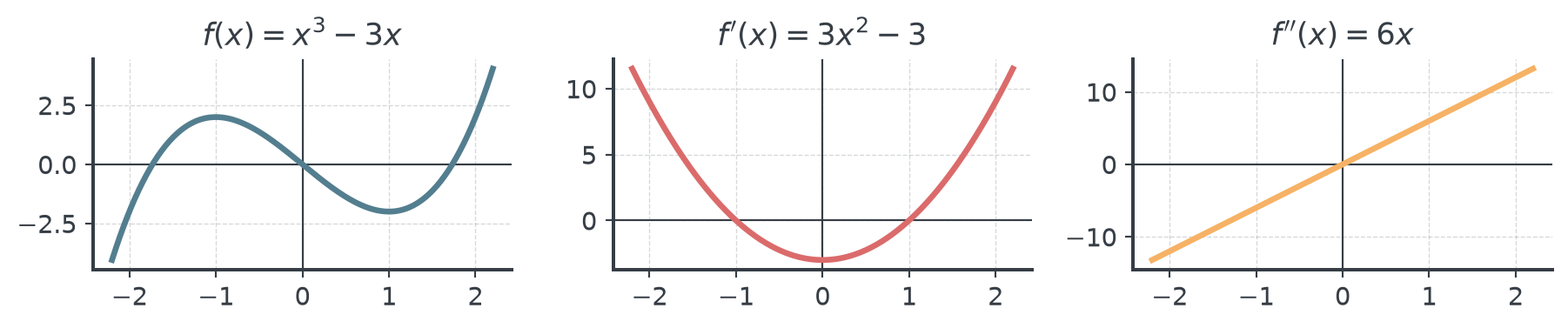
- For \(x < 0\): \(f'' < 0\): slope falling, \(f\) bends downward (concave)
- For \(x > 0\): \(f'' > 0\): slope rising, \(f\) bends upward (convex)
- At \(x = 0\) the bend switches, an inflection point; Session 5 turns these signs into an optimisation tool
Your Turn: What Does \(C''(q) > 0\) Mean Here?
Question
A warehouse’s handling cost \(C(q)\) satisfies \(C'(q) > 0\) and \(C''(q) > 0\) for all realistic \(q\). What does each sign say about the next pallet?
- \(C'(q) > 0\): handling more pallets costs more, the cost curve rises
- \(C''(q) > 0\): each additional pallet costs more than the previous one, the rise steepens
- Business reading: the warehouse strains against capacity, the cost curve is convex
Marginal Analysis
Marginal Cost
Economists call \(C'(q)\) the marginal cost at output level \(q\):
- Exact meaning: the instantaneous rate at which cost grows at \(q\)
- Practical meaning: approximately the cost of one more unit
- Why: with \(h = 1\) in the difference quotient, \(C'(q) \approx \dfrac{C(q+1) - C(q)}{1}\)
- One unit is a small nudge next to hundreds produced, so the tangent slope is an excellent stand-in
Worked Reading: What Does \(C'(50)\) Say?
Take today’s cost function \(C(q) = 0.5q^2 + 10q + 200\), so \(C'(q) = q + 10\).
- \(C'(50) = 60\), at 50 units, cost grows at €60 per unit
- Reading: the 51st unit costs approximately €60 to produce
- Exact check: \(C(51) - C(50) = 2010.5 - 1950 = 60.5\), the approximation is off by 50 cents
- And \(C''(q) = 1 > 0\): marginal cost is increasing, every further unit is dearer
Mind the units: \(C'(q)\) is € per unit, not €: a rate, not a cost.
Your Turn: The 101st Unit
Question
Same cost function, \(C(q) = 0.5q^2 + 10q + 200\). Approximately what does the 101st unit cost? Type the number.
\[C'(100) = 100 + 10 = 110 \qquad \text{so about €110}\]
Exact check: \(C(101) - C(100) = 6310.5 - 6200 = 110.5\). Again the tangent slope misses by 50 cents, and it is far quicker than the subtraction.
Marginal Revenue
The same idea on the revenue side, sell \(q\) units, earn \(R(q)\):
- Marginal revenue \(R'(q)\): approximately the revenue from one more unit sold
- It usually falls with \(q\), selling more requires lowering the price
- Producing one more unit pays off while \(R'(q) > C'(q)\), the extra revenue beats the extra cost
- Where the two rates meet lies the profit-maximal output, Session 5 makes this precise
Elasticity of Demand
Rates in units depend on the units, pricing needs percentages. For a demand function \(D(p)\):
\[\varepsilon = \frac{p}{D(p)} \cdot D'(p)\]
- Reading: a 1% price increase changes demand by about \(\varepsilon\) percent
- Demand falls in price, so \(\varepsilon\) is negative
- \(|\varepsilon| > 1\): elastic, demand overreacts to price
- \(|\varepsilon| < 1\): inelastic, demand barely reacts
Worked Example: Pricing a Delivery Service
Weekly demand for a same-day delivery service: \(D(p) = 500 - 10p\), so \(D'(p) = -10\).
- At \(p = 20\): \(D(20) = 300\), so \(\varepsilon = \frac{20}{300} \cdot (-10) \approx -0.67\)
- Inelastic: raising the price 1% loses only 0.67% of demand, revenue rises
- At \(p = 30\): \(D(30) = 200\), so \(\varepsilon = -1.5\), elastic: a price increase now backfires
- The switch sits at \(\varepsilon = -1\) (here \(p = 25\)), exactly where revenue \(p \cdot D(p)\) peaks
Your Turn: Raise the Price or Not?
Question
At the current price, a freight forwarder estimates the elasticity of demand at \(\varepsilon = -0.4\). Elastic or inelastic, and what does a small price increase do to revenue?
- \(|\varepsilon| = 0.4 < 1\): inelastic, customers barely react
- A 1% price increase loses only about 0.4% of demand
- Price up, demand almost unchanged: revenue increases, typical for services customers depend on
Closing
Key Takeaways
- The derivative \(f'(a) = \lim_{h \to 0} \frac{f(a+h) - f(a)}{h}\) is the instantaneous rate of change, the tangent’s slope
- Kinks and jumps break differentiability, smooth graphs are safe
- Power, sum, product, quotient and chain rule handle every gallery function
- \(e^x\) is its own derivative, growth proportional to the current level
- \(f''\) measures curvature: \(f'' \geq 0\) convex, \(f'' \leq 0\) concave, the chord intuition, formalised
- \(C'(q) \approx\) cost of one more unit; elasticity \(\varepsilon\) compares percentage reactions
That’s it for today.
Any Questions?
Until the Next Session
- Work through the Tasks: the drilling happens there, with worked solutions
- Check yourself with the Self-Test quiz
- Keep the Cheatsheet next to you, the rule table lives on it
- Note down anything unclear, we start next session with your questions
When differentiating, name the structure first: sum, product, quotient or chain? The right rule follows automatically.
Preview: Session 05: Single Variable Optimization
- Central question: where is a function largest or smallest?
- The recipe: set \(f'\) to zero (flat tangent) and ask \(f''\) whether it is a peak or a valley
- Best output, best price, best order quantity
- Today’s rules become the toolkit, differentiation was the warm-up
See you there, and bring your questions!
Literature & Further Reading
- These sessions cover the essentials: textbooks offer more depth and practice
- Start with Sydsæter et al. (2012) or Jacques (2015); full recommendations on the tutorial’s literature page
Jacques, Ian. 2015. Mathematics for Economics and Business. 8th ed. Always Learning. Pearson.
Sydsæter, Knut, Peter J. Hammond, and Arne Strøm. 2012. Essential Mathematics for Economic Analysis. 4th ed. Pearson.
Session 04 - Differentiation | Dr. Tobias Vlcek | Home