
Session 03 - Functions
Mathematics for Master Students
Dr. Tobias Vlcek
Recap & Your Questions
Session 02 in a Nutshell
- A set is an unordered collection of distinct elements: \(\in\) for elements, \(\subseteq\) for sets
- \(\cup\), \(\cap\), \(\setminus\), \(^c\) mirror or, and, not: De Morgan flips \(\cup\) and \(\cap\)
- Counting a union: \(|A \cup B| = |A| + |B| - |A \cap B|\)
- \(A \times B\) collects ordered pairs: \(\mathbb{R} \times \mathbb{R} = \mathbb{R}^2\) is the plane
- Constraints are sets, and they combine by intersection
- Today: functions map between sets, and their graphs live in \(\mathbb{R}^2\)
Common Issues in the Homework
- Element vs subset: braces build a set: \(\{2\} \subseteq A\) pairs with \(\subseteq\), while \(2 \in A\) pairs with \(\in\); mixing them was the most frequent slip
- Complements reverse inclusion: from \(A \subseteq B\) it follows that \(B^c \subseteq A^c\): writing \(A^c \subseteq B^c\) is the classic inversion error
- Mixed \(\cup\) and \(\cap\): \(A \cap B \cup C\) is ambiguous: grouping changes the set, so always add parentheses
Which tasks gave you trouble? Bring them up now: we take the time to go through them before we move on to today’s topic.
Warm-Up: One Quick Evaluation
Question
Let \(A = \{1, 2, 3, 4\}\) and \(B = \{3, 4, 5\}\). Compute \(\;(A \cup B) \setminus (A \cap B)\).
- Inside out: \(A \cup B = \{1, 2, 3, 4, 5\}\) and \(A \cap B = \{3, 4\}\)
- Removing the intersection: \((A \cup B) \setminus (A \cap B) = \{1, 2, 5\}\)
- In words: everything in exactly one of the two sets: “either, but not both”
Today’s Plan
- What is a function?: exactly one output for every input
- Function gallery: linear, quadratic, polynomial, rational, exponential, logarithm
- Domain in practice: which inputs are allowed
- Combining functions: composition and inverses
- Properties: monotone, bounded, convex vs concave
Functions as Mappings
What Is a Function?
A function \(f: A \to B\) is a rule that assigns to each element \(x \in A\) exactly one element \(f(x) \in B\).
- It maps between two sets: the ones from last session
- Think of a machine: input \(x\) goes in, output \(f(x)\) comes out
- “Exactly one” makes it predictable: same input, same output, every time
Common Mistake
“Exactly one” restricts the outputs per input. Two different inputs may share the same output: that is perfectly fine.
Function Notation
\[f: \mathbb{R} \to \mathbb{R}, \quad x \mapsto 2x + 5\]
- \(f\) is the function’s name; \(x\) is the input, also called the argument
- \(f(x)\) is the output: read “\(f\) of \(x\)”; here \(f(x) = 2x + 5\)
- \(x \mapsto f(x)\) reads “\(x\) maps to \(f(x)\)”: note the little bar on the arrow
- \(f: A \to B\) names the two sets: inputs come from \(A\), outputs land in \(B\)
\(f\) and \(f(x)\) are different things: \(f\) is the rule, \(f(x)\) is a number: the value at \(x\).
Domain, Codomain, Range
For \(f: A \to B\), three sets matter:
- The domain \(A\): all allowed inputs
- The codomain \(B\): where outputs are declared to land
- The range \(f(A) = \{f(x) : x \in A\}\): the outputs that actually occur
- Always \(f(A) \subseteq B\): the range is a subset of the codomain
Example: \(f: \mathbb{R} \to \mathbb{R}\), \(f(x) = x^2\): codomain \(\mathbb{R}\), but range \([0, \infty)\): no square is negative.
Your Turn: What Is the Range?
Question
\(f: \mathbb{R} \to \mathbb{R}\), \(f(x) = x^2 + 1\). Which set is the range of \(f\)?
| (a) \(\mathbb{R}\) | (b) \([0, \infty)\) |
| (c) \([1, \infty)\) | (d) \((1, \infty)\) |
(c): \(x^2 \geq 0\), so \(x^2 + 1 \geq 1\), and the value \(1\) is reached at \(x = 0\): square bracket.
- is the codomain, not the range: the declared landing zone is larger than the outputs that actually occur.
Evaluating a Function
To evaluate, substitute the input everywhere the variable appears, take \(f(x) = x^2 - 2x\):
- \(f(3) = 3^2 - 2 \cdot 3 = 9 - 6 = 3\)
- \(f(0) = 0 - 0 = 0\)
- \(f(-1) = (-1)^2 - 2 \cdot (-1) = 1 + 2 = 3\)
- Note: \(f(3) = f(-1) = 3\): two inputs, same output, allowed
Put negative inputs in parentheses before squaring: \((-1)^2 = 1\), not \(-1\).
Plugging in Whole Expressions
The input can be an expression: substitute all of it, in parentheses. Again \(f(x) = x^2 - 2x\):
\[f(a + h) = (a + h)^2 - 2(a + h) = a^2 + 2ah + h^2 - 2a - 2h\]
Common Mistake
\(f(a + h) \neq f(a) + f(h)\), check: \(f(1 + 1) = f(2) = 0\), but \(f(1) + f(1) = -1 - 1 = -2\).
Expressions like \(f(a + h)\) are the raw material of Session 4: “how much does \(f\) change when the input moves by \(h\)?”
Your Turn: Evaluate
Question
Again \(f(x) = x^2 - 2x\). What is \(f(-2)\)? Type the number. Bonus: simplify \(f(x + 1)\).
\[f(-2) = (-2)^2 - 2 \cdot (-2) = 4 + 4 = 8\]
\[f(x + 1) = (x + 1)^2 - 2(x + 1) = x^2 + 2x + 1 - 2x - 2 = x^2 - 1\]
Common Mistake
\(f(-2) = 0\) comes from dropping a sign: either \((-2)^2 = -4\) or \(-2 \cdot (-2) = -4\). Both minus signs matter.
The Vertical Line Test
The graph of \(f\) is the set \(\{(x, f(x)) : x \in A\} \subseteq \mathbb{R}^2\): ordered pairs, as in Session 2.
- A curve is the graph of a function \(\Leftrightarrow\) every vertical line hits it at most once
- Why: one input \(x\) must yield exactly one output
- The circle \(x^2 + y^2 = 1\) fails: at \(x = 0\) it contains two points, \(y = 1\) and \(y = -1\)
- Lines, parabolas and exponential curves all pass
Your Turn: Which Graph Is a Function?
Question
Which of the two graphs shows \(y\) as a function of \(x\)?
Only Graph B: A fails the vertical line test: \(x = 1\) gives both \(y = 1\) and \(y = -1\). The kink in B is fine.
Functions in Business
Functions map decisions to outcomes, the core of every quantitative model:
- Cost function \(C(q)\): production quantity \(\to\) total cost
- Demand function \(D(p)\): price \(\to\) units sold
- Production function: input (labour hours) \(\to\) output (units)
- One decision in, one predicted outcome out: that is why models must be functions
Whenever a spreadsheet column is computed from another column, there is a function behind it.
Function Gallery
Linear Functions
\[f(x) = mx + b\]
- Slope \(m\): the output changes by \(m\) for each unit of input, constant everywhere
- Intercept \(b = f(0)\): the starting level
- From two points on the graph: \(m = \frac{f(x_2) - f(x_1)}{x_2 - x_1}\)
- The workhorse of business models: constant rates
A Linear Cost Function
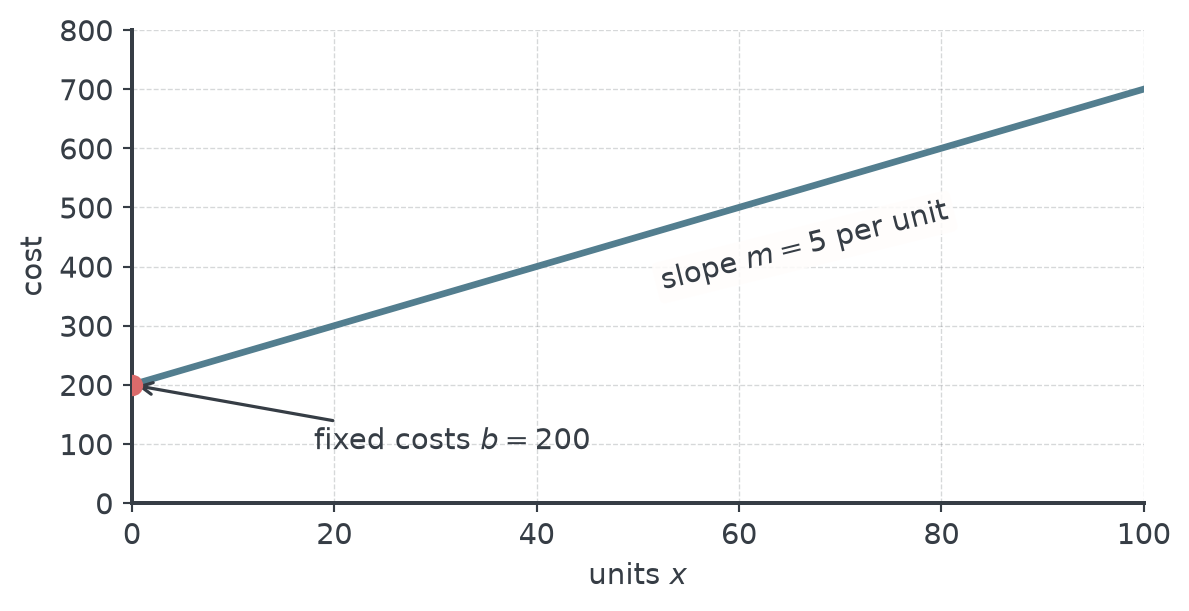
\(C(x) = 200 + 5x\): the fixed costs are the intercept, the variable cost per unit is the slope.
Your Turn: Slope from Two Points
Question
A linear cost function gives \(C(10) = 250\) and \(C(30) = 350\). What are the slope \(m\) and the intercept \(b\)? Type both numbers.
- Slope: \(m = \dfrac{350 - 250}{30 - 10} = \dfrac{100}{20} = 5\), €5 of variable cost per unit
- Intercept: \(b = C(10) - 5 \cdot 10 = 250 - 50 = 200\), the fixed costs
- So \(C(x) = 200 + 5x\): the function from the plot, recovered from two data points
Quadratic Functions
\[f(x) = ax^2 + bx + c, \quad a \neq 0\]
- The graph is a parabola: opens upward if \(a > 0\), downward if \(a < 0\)
- The turning point is the vertex, located at \(x = -\frac{b}{2a}\)
- Downward parabolas model trade-offs: revenue rises with price, until demand collapses
A Quadratic Revenue Function
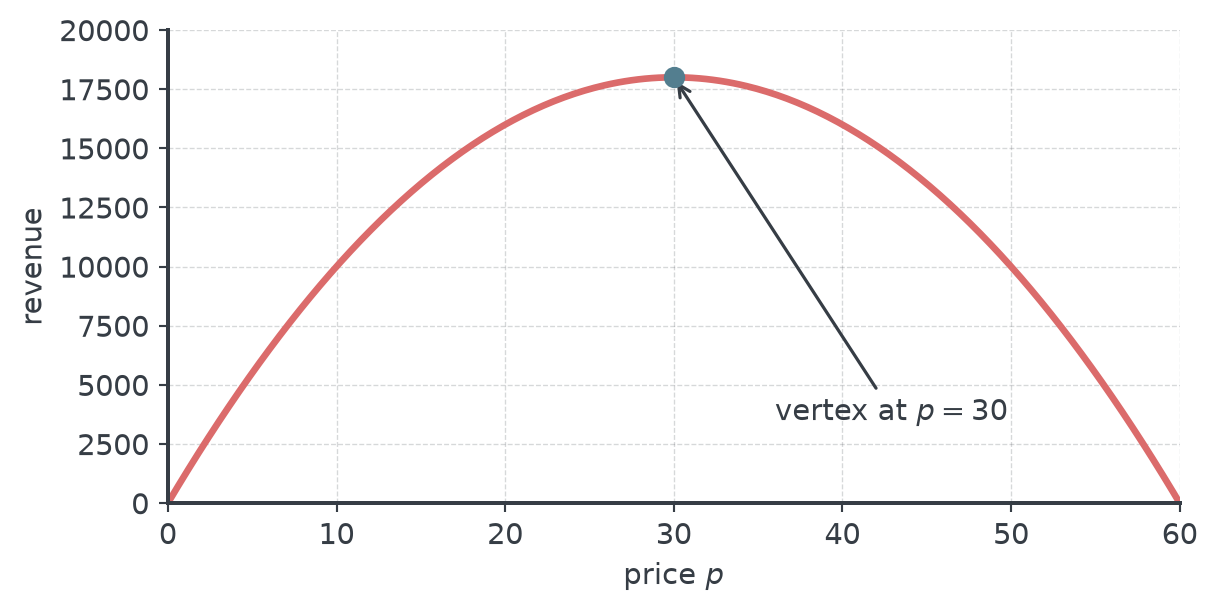
Demand \(D(p) = 1200 - 20p\) gives revenue \(R(p) = p \cdot D(p) = 1200p - 20p^2\): the vertex \(p = -1200/(2 \cdot (-20)) = 30\) is the revenue-maximal price.
Your Turn: Where Is the Vertex?
Question
Another product has revenue \(R(p) = 800p - 10p^2\). Does the parabola open upward or downward, and at which price is the vertex? Type the number.
- \(a = -10 < 0\): the parabola opens downward, the vertex is the revenue peak
- Vertex at \(p = -\dfrac{b}{2a} = -\dfrac{800}{2 \cdot (-10)} = 40\)
- Check: the demand behind it is \(D(p) = 800 - 10p\), which hits zero at \(p = 80\), and the peak sits halfway
Polynomials
\[f(x) = a_n x^n + \dots + a_1 x + a_0 \qquad \text{degree } n = \text{highest power}\]
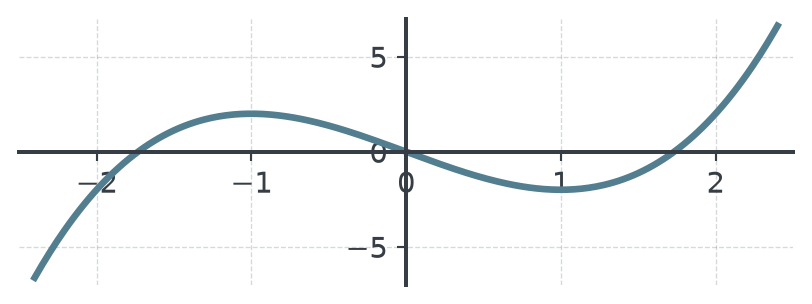
Degree \(n\) allows up to \(n\) roots and up to \(n - 1\) turning points: far from the origin the leading term \(a_n x^n\) dominates (\(f(x) = x^3 - 3x\) above behaves like \(x^3\)).
Cubic cost curves \(C(x) = ax^3 + bx^2 + cx + d\) are the classic economics example: costs rise steeply, flatten, then steepen again.
Rational Functions
\[f(x) = \frac{p(x)}{q(x)} \qquad \text{a quotient of two polynomials}\]
- Defined only where \(q(x) \neq 0\): division by zero is the first domain trap
- Near a zero of the denominator, values explode: a vertical asymptote
- For large inputs, the graph can settle toward a horizontal asymptote
The Hyperbola \(f(x) = 1/x\)
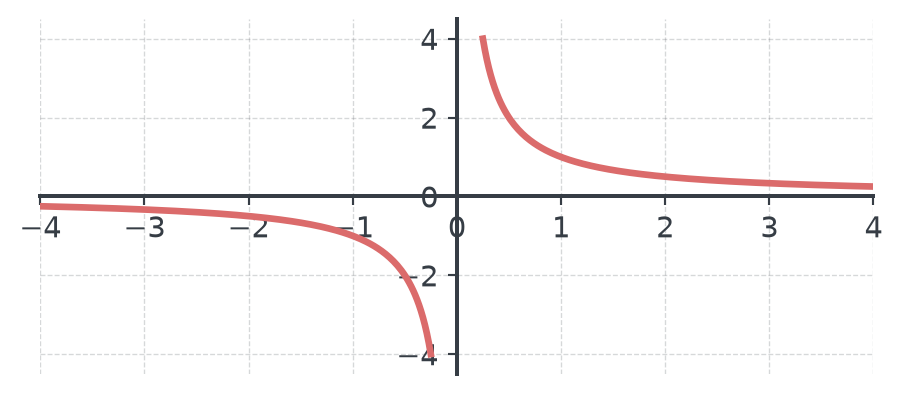
Both axes are asymptotes. Business example: with \(C(x) = 200 + 5x\), the cost per unit is \(C(x)/x = 200/x + 5\): it falls toward 5 as volume grows: economies of scale.
Exponential Functions
\[f(x) = a \cdot b^x, \quad b > 0\]
- The variable sits in the exponent: each step multiplies by \(b\)
- \(b > 1\): growth (interest, booming demand); \(0 < b < 1\): decay (depreciation, churn)
- \(a = f(0)\) is the starting value
- The standard base is Euler’s number \(e \approx 2.71828\): Sessions 4–5 show why it is so convenient
Growth and Decay
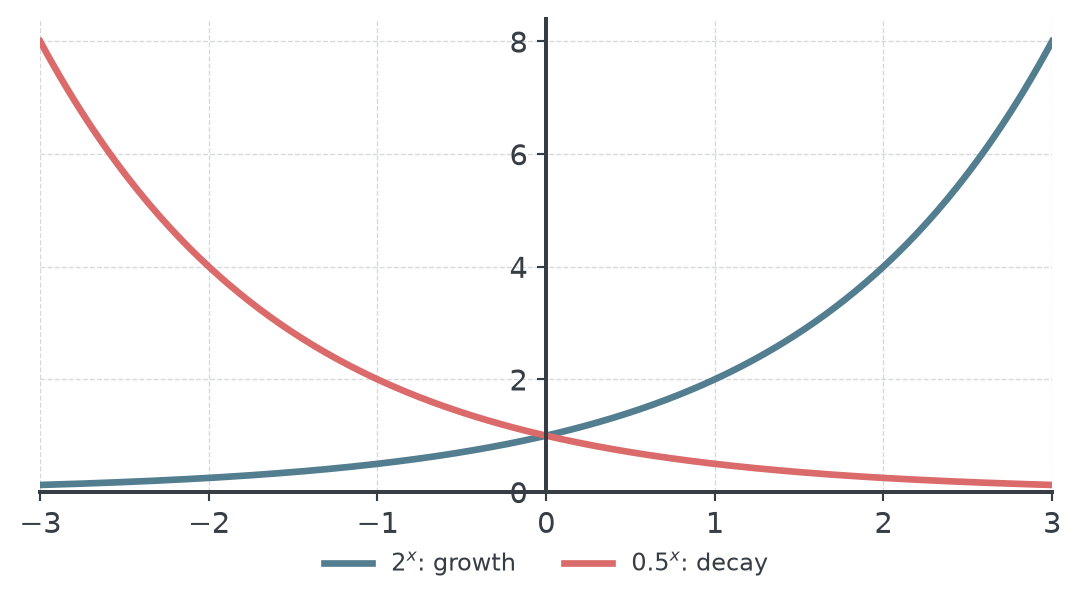
Both stay strictly positive and pass through \((0, 1)\): an exponential never reaches zero.
Your Turn: Growth or Decay?
Question
A delivery van’s resale value follows \(V(t) = 50000 \cdot 0.8^t\) (in €, after \(t\) years). Which statement is true?
| (a) The value grows by \(20\%\) per year | (b) The value shrinks by \(20\%\) per year |
| (c) The value shrinks by €10000 per year | (d) The value reaches €0 after \(5\) years |
(b): base \(0.8 < 1\) means decay, and each year keeps \(80\%\) of the previous value.
Common Mistake
- is the first year only: \(50000 \to 40000\). The second year loses \(8000\), the third \(6400\). And (d) never happens: an exponential stays strictly positive.
Compound Interest
Deposit \(K_0\) at annual rate \(r\), each year multiplies the balance by \((1 + r)\):
\[K_t = K_0 \cdot \underbrace{(1+r)(1+r) \dots (1+r)}_{t \text{ factors}} = K_0 \cdot (1+r)^t\]
- Session 1’s product idea in action: repeated multiplication becomes a power
- €1000 at \(r = 0.05\): after 15 years \(1000 \cdot 1.05^{15} \approx\) €2079: more than doubled
- As a function of time \(t\), this is exponential growth with base \(b = 1.05\)
Logarithms: Undoing \(e^x\)
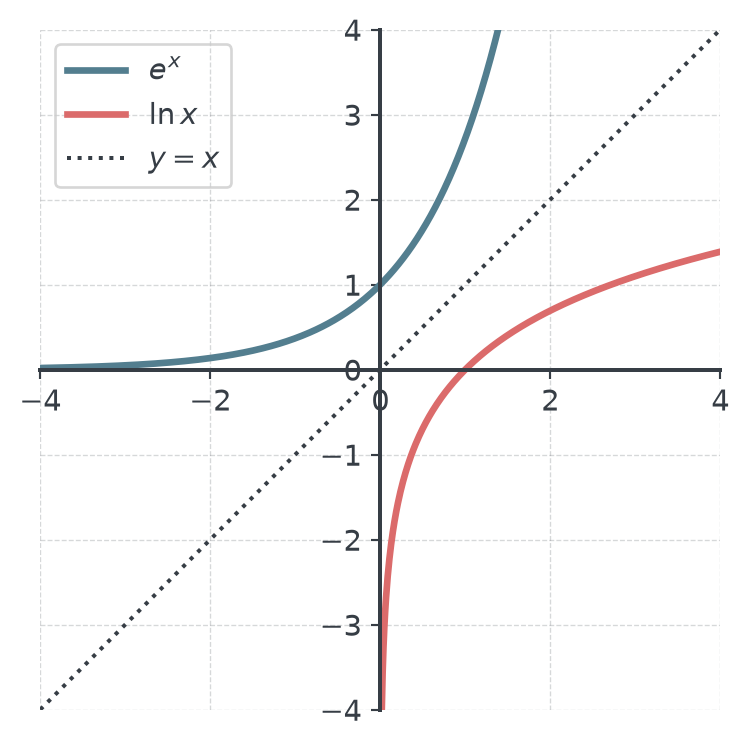
The natural logarithm \(\ln x\) answers: which exponent produces \(x\)?
\[y = \ln x \;\, \Leftrightarrow \;\, x = e^y\]
- \(\ln x\) is the mirror image of \(e^x\) across the diagonal
- Defined only for \(x > 0\)
- \(\ln 1 = 0\) and \(\ln e = 1\)
Rules for Logarithms
\[\ln(xy) = \ln x + \ln y \qquad \ln\frac{x}{y} = \ln x - \ln y \qquad \ln(x^k) = k \ln x\]
- Logs turn products into sums and powers into multiples
- The power rule pulls the unknown down from the exponent: that is why logs solve growth questions
- Other bases reduce to \(\ln\): \(\log_b x = \frac{\ln x}{\ln b}\)
Common Mistake
\(\ln(x + y) \neq \ln x + \ln y\): the rules work for products, not sums.
Your Turn: Which Log Rule?
Question
Which expression equals \(\;\ln(x^2 y)\;\) for \(x, y > 0\)?
| (a) \(2 \ln x + \ln y\) | (b) \(2 \ln x \cdot \ln y\) |
| (c) \(\ln(x^2) \cdot \ln y\) | (d) \(2\,(\ln x + \ln y)\) |
(a): the product rule splits \(\ln(x^2 y) = \ln(x^2) + \ln y\), then the power rule gives \(\ln(x^2) = 2 \ln x\).
- would be \(\ln(x^2 y^2)\): the factor \(2\) belongs to \(x\) only, so apply the power rule after splitting the product.
Solving for the Exponent
When the unknown sits in the exponent, take \(\ln\) on both sides and pull it down.
Question: a warehouse’s throughput grows \(8\%\) per year. After how many years has it tripled?
- Model: \(1.08^t = 3\)
- Take logs: \(\ln(1.08^t) = \ln 3\), so \(t \ln 1.08 = \ln 3\)
- Solve: \(t = \dfrac{\ln 3}{\ln 1.08} \approx \dfrac{1.0986}{0.0770} \approx 14.3\) years
The same three steps handle every “how long until” question with exponential growth.
Your Turn: When Has It Doubled?
Question
With continuous growth at rate \(r\), capital follows \(K_t = K_0 \cdot e^{rt}\). When has it doubled?
\[e^{rt} = 2 \quad \Rightarrow \quad rt = \ln 2 \quad \Rightarrow \quad t = \frac{\ln 2}{r} \approx \frac{0.693}{r}\]
- At \(r = 5\%\): \(t \approx \frac{0.693}{0.05} \approx 13.9\) years: independent of the starting amount
- The same trick handles yearly compounding: \(1.05^t = 2\) gives \(t = \frac{\ln 2}{\ln 1.05} \approx 14.2\) years
Domain in Practice
The Maximal Domain
If no domain is stated, take the maximal domain: the largest set of reals on which the formula is defined.
Three red flags:
- Division by zero: denominators must stay \(\neq 0\)
- Even roots of negatives: under \(\sqrt{\phantom{x}}\) we need \(\geq 0\)
- Logs of non-positives: inside \(\ln\) we need \(> 0\) (strictly!)
Everything else (polynomials, exponentials) is safe on all of \(\mathbb{R}\).
Finding the Domain: Examples
| Function | Restriction | Maximal domain |
|---|---|---|
| \(\dfrac{1}{x - 3}\) | \(x - 3 \neq 0\) | \(\mathbb{R} \setminus \{3\}\) |
| \(\sqrt{2x + 6}\) | \(2x + 6 \geq 0\) | \([-3, \infty)\) |
| \(\ln(5 - x)\) | \(5 - x > 0\) | \((-\infty, 5)\) |
The results are intervals. Session 1’s notation pays off: square bracket at \(-3\) (\(\sqrt{0}\) is fine), round bracket at \(5\) (\(\ln 0\) is not).
Your Turn: Find the Domain
Question
What is the maximal domain of \(\;f(x) = \dfrac{\sqrt{x - 2}}{x - 4}\;\)?
- The root needs \(x - 2 \geq 0\), so \(x \geq 2\)
- The denominator needs \(x - 4 \neq 0\), so \(x \neq 4\)
- Both must hold, intersect the conditions: \([2, 4) \cup (4, \infty)\)
Collect every restriction first, then combine: one forgotten condition is the typical exam slip.
Domains in Business
Business adds its own restrictions on top of the maths:
- Quantities are non-negative: \(q \in [0, \infty)\): no producing \(-50\) pallets
- Capacity caps the allowed quantities: \(q \in [0, 500]\)
- Prices must keep demand meaningful: \(D(p) = 1200 - 20p \geq 0\) forces \(p \in [0, 60]\)
- Model domain = mathematical domain \(\cap\) business constraints: an intersection, as in Session 2
Combining Functions
Composition of Functions
Chaining two functions, apply \(g\) first, then \(f\) to the result:
\[(f \circ g)(x) = f(g(x))\]
- Read from the inside out: the inner function acts first
- Example: \(g(x) = 2x\) and \(f(x) = x + 3\): \(\;(f \circ g)(x) = f(2x) = 2x + 3\)
- But \((g \circ f)(x) = g(x + 3) = 2x + 6\): not the same
- Business reading: multi-stage processes, the output of one stage feeds the next
Order Matters: Voucher and VAT
A webshop applies a €10 voucher \(v(p) = p - 10\) and 19% VAT \(t(p) = 1.19p\) to a net price \(p\):
- Voucher first, then tax: \((t \circ v)(p) = 1.19(p - 10) = 1.19p - 11.90\)
- Tax first, then voucher: \((v \circ t)(p) = 1.19p - 10\)
- The results differ by €1.90 on every order: for the customer, voucher first is cheaper
Common Mistake
Assuming \(f \circ g = g \circ f\): in general, the order cannot be swapped. Always check which function acts first.
Your Turn: Compose in the Right Order
Question
Let \(f(x) = x^2\) and \(g(x) = x + 1\). Compute \(\;(f \circ g)(2)\;\) and \(\;(g \circ f)(2)\).
- \((f \circ g)(2) = f(g(2)) = f(3) = 9\)
- \((g \circ f)(2) = g(f(2)) = g(4) = 5\)
- Inside out, always, and the order visibly changes the answer
Inverse Functions
The inverse \(f^{-1}\) undoes \(f\):
\[f(a) = b \quad \Leftrightarrow \quad f^{-1}(b) = a\]
- It exists only if \(f\) is one-to-one: every output comes from exactly one input
- Graph check: every horizontal line hits the graph at most once
- \(f(x) = x^2\) on \(\mathbb{R}\) fails: \(f(2) = f(-2) = 4\): which input produced \(4\)?
- Restricting to \([0, \infty)\) repairs it: there \(f^{-1}(x) = \sqrt{x}\)
Finding an Inverse
Write \(y = f(x)\), solve for \(x\), then read the result as a function of the output.
Demand example: \(q = D(p) = 1200 - 20p\):
\[q = 1200 - 20p \quad \Rightarrow \quad 20p = 1200 - q \quad \Rightarrow \quad p = 60 - \frac{q}{20}\]
- \(D^{-1}(q) = 60 - \frac{q}{20}\): the price needed to sell exactly \(q\) units
- Check with a pair: \(D(30) = 600\) and \(D^{-1}(600) = 60 - 30 = 30\) ✓
- Domain and range swap: the domain of \(D^{-1}\) is the range of \(D\)
Your Turn: Undo the Function
Question
Let \(f(x) = 3x - 6\). For which \(x\) is \(f(x) = 9\), i.e. what is \(f^{-1}(9)\)? Type the number.
- Solve \(3x - 6 = 9\): \(\;3x = 15\), so \(x = 5\)
- In general: \(y = 3x - 6 \Rightarrow x = \dfrac{y + 6}{3}\), hence \(f^{-1}(y) = \dfrac{y + 6}{3}\)
- Check: \(f^{-1}(9) = \dfrac{15}{3} = 5\) ✓
The Notation Trap: \(f^{-1} \neq 1/f\)
- \(f^{-1}(x)\) is the inverse function: the \(-1\) sits on the function name
- The reciprocal of the value is written \((f(x))^{-1} = \frac{1}{f(x)}\)
- Example \(f(x) = 2x\): \(\;f^{-1}(x) = \frac{x}{2}\), but \(\frac{1}{f(x)} = \frac{1}{2x}\): completely different
Common Mistake
Reading \(f^{-1}\) as “one over \(f\)”: for functions, the exponent \(-1\) means undo, not divide.
The Mirror Property
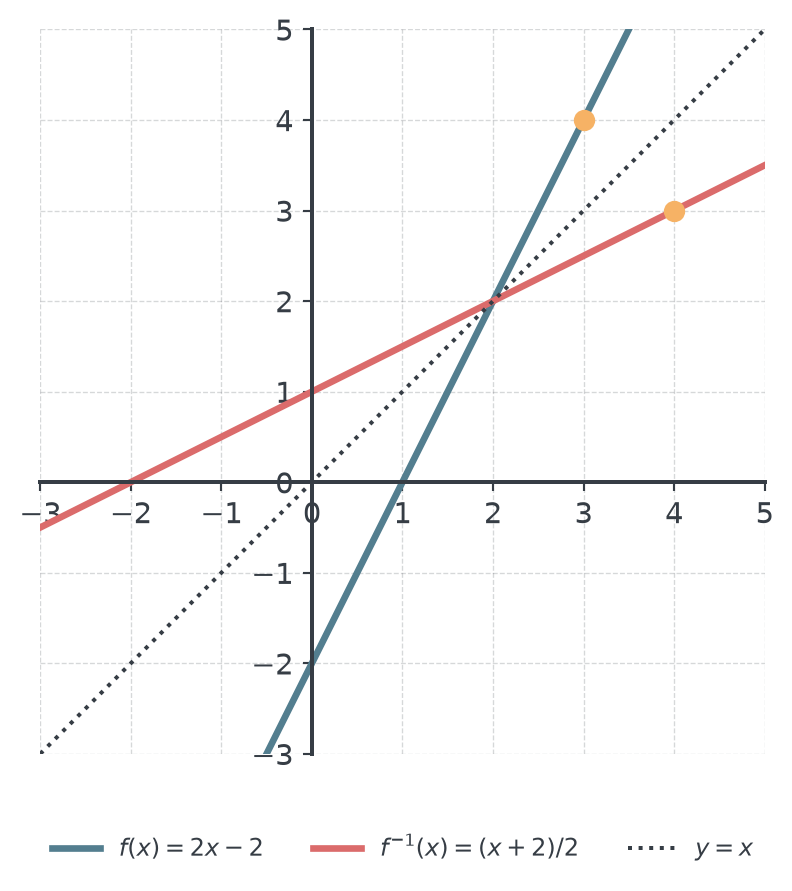
Swapping input and output reflects the graph across \(y = x\): the point \((3, 4)\) on \(f\) becomes \((4, 3)\) on \(f^{-1}\): exactly how \(\ln x\) mirrored \(e^x\).
Properties
Monotonicity
\(f\) is increasing if \(x_1 < x_2 \Rightarrow f(x_1) \leq f(x_2)\): strictly increasing with \(<\). Decreasing works the same way, flipped.
- Graph reading: strictly increasing = rises left to right, everywhere
- Costs increase in quantity; demand decreases in price
- Strictly monotone \(\Rightarrow\) one-to-one \(\Rightarrow\) invertible: that is why \(e^x\) has an inverse but \(x^2\) on \(\mathbb{R}\) does not
Your Turn: Invertible or Not?
Question
Which of these functions is not one-to-one on \(\mathbb{R}\), and therefore has no inverse there?
| (a) \(f(x) = 2x + 1\) | (b) \(f(x) = e^x\) |
| (c) \(f(x) = x^2 - 4\) | (d) \(f(x) = x^3\) |
(c): \(f(2) = f(-2) = 0\), one output from two inputs, so it fails the horizontal line test.
The other three are strictly increasing on all of \(\mathbb{R}\), and strictly monotone functions are always invertible.
Boundedness
\(f\) is bounded above if some \(M\) satisfies \(f(x) \leq M\) for all \(x\): bounded below works with \(\geq m\).
- \(e^x > 0\): bounded below by \(0\), unbounded above
- A market share lives in \([0, 1]\): bounded on both sides
- \(f(x) = x^2\): bounded below by \(0\), but grows without limit
- Bounds tell you what a model can, and cannot, predict
Convex or Concave?
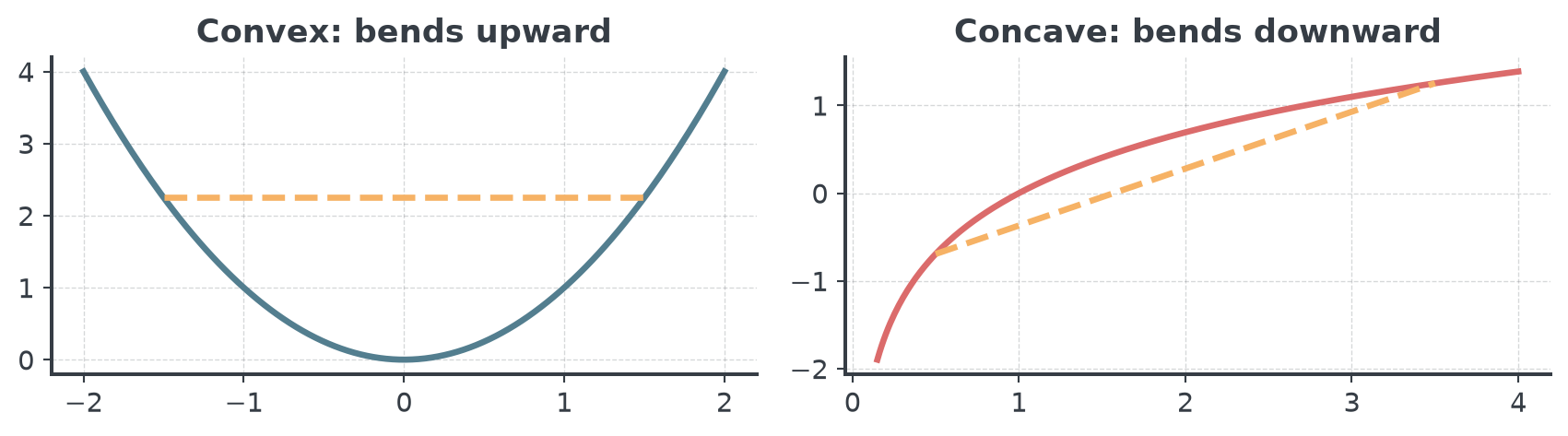
- Convex: for two graph points, the chord lies above the graph: \(x^2\), \(e^x\)
- Concave: the chord lies below the graph: \(\ln x\), \(\sqrt{x}\): diminishing returns
- Intuition only for now: Sessions 4–5 make it precise and find optima
Your Turn: Chord Check
Question
Which of these functions is concave on its domain?
| (a) \(x^2\) | (b) \(e^x\) |
| (c) \(\sqrt{x}\) | (d) \(\lvert x \rvert\) |
(c): \(\sqrt{x}\) rises ever more slowly, its chords lie below the graph: diminishing returns.
- and (b) bend upward, and the chords of \(\lvert x \rvert\) also lie above its graph: all three are convex. Session 4 turns the chord test into a sign test on \(f''\).
Closing
Key Takeaways
- A function assigns each input exactly one output: domain, codomain and range are sets
- Know the gallery shapes: linear, quadratic, polynomial, rational, exponential, logarithm
- \(\ln x\) undoes \(e^x\): the power rule \(\ln(x^k) = k \ln x\) solves for exponents
- Maximal domain: no division by zero, no even roots of negatives, no logs of non-positives
- Composition chains processes: order matters; inverses undo, but only one-to-one functions have them
- Monotone, bounded, convex/concave: reading behaviour from a graph
That’s it for today.
Any Questions?
Until the Next Session
- Work through the Tasks: problems with worked solutions
- Check yourself with the Self-Test quiz
- Keep the Cheatsheet next to you while practising
- Note down anything unclear: we start next session with your questions
When a function confuses you, sketch it: five plotted points reveal more than ten minutes of staring at the formula.
Preview: Session 04: Differentiation
- Central question: how fast does a function change?
- Slopes of curved graphs: the tangent line
- Today’s \(f(a + h)\) becomes the difference quotient
- Marginal cost and marginal revenue: the language of economic decisions
- And \(e^x\) reveals its superpower
See you there, and bring your questions!
Literature & Further Reading
- These sessions cover the essentials: textbooks offer more depth and practice
- Start with Sydsæter et al. (2012) or Jacques (2015); full recommendations on the tutorial’s literature page
Jacques, Ian. 2015. Mathematics for Economics and Business. 8th ed. Always Learning. Pearson.
Sydsæter, Knut, Peter J. Hammond, and Arne Strøm. 2012. Essential Mathematics for Economic Analysis. 4th ed. Pearson.
Session 03 - Functions | Dr. Tobias Vlcek | Home